The Evolution of Corvit into a Leading IT, OT & Telecom and MSSP Solutions Provider
May 22, 2026Learn how security awareness training helps employees spot phishing, resist social engineering and reduce cyber risks with CORVIT MSSP.
Introduction
Cybersecurity is often associated with firewalls, endpoint protection, threat detection platforms, and advanced security operations. These technologies are essential, but they cannot independently prevent every incident that begins with a human decision.
An employee clicks a convincing phishing link. A finance professional approves a fraudulent payment request. A user shares a one-time authentication code with someone impersonating the IT department. Another employee notices unusual activity but does not report it because they are unsure whether it matters.
Each situation can create an opportunity for attackers to compromise an organization.
This is why the human element remains an important consideration in cybersecurity. Employees interact with emails, applications, customers, suppliers, business systems, and sensitive information every day. Their decisions can either increase exposure or help prevent an incident from escalating.
The concept of a human firewall describes an organization’s ability to use informed, security-conscious employees as an additional layer of defense. It does not mean expecting every employee to become a cybersecurity expert. It means helping people recognize common threats, make safer decisions, and report suspicious activity before it develops into a larger problem.
For organizations across Qatar and the wider GCC, building this capability is an important part of operational readiness. Security awareness must go beyond an annual presentation or a mandatory training certificate. It should become a practical, measurable part of everyday business operations.
What Is a Human Firewall?
A human firewall is a workforce that understands common cybersecurity risks and applies appropriate security practices during daily activities.
Traditional security controls are designed to prevent, detect, or contain threats through technical mechanisms. A human firewall complements these controls by improving how employees respond to situations that technology may not fully prevent or resolve on its own.
For example, an email security gateway may filter known malicious messages, but a sophisticated business email compromise attempt can appear to come from a legitimate supplier. An employee who independently verifies an unexpected change to bank details may prevent a fraudulent transaction that technical filtering alone did not stop.
Similarly, multifactor authentication can strengthen account security, but users still need to understand authentication prompts and recognize unexpected requests that could indicate an attempted account compromise.
An effective human firewall therefore combines three capabilities: recognition, decision-making, and reporting. Employees need to recognize potential threats, make informed choices when something appears unusual, and know how to report concerns through an established process.
The objective is not to eliminate human error. It is to reduce the likelihood that a mistake becomes a security incident and improve the organization’s ability to identify problems early.
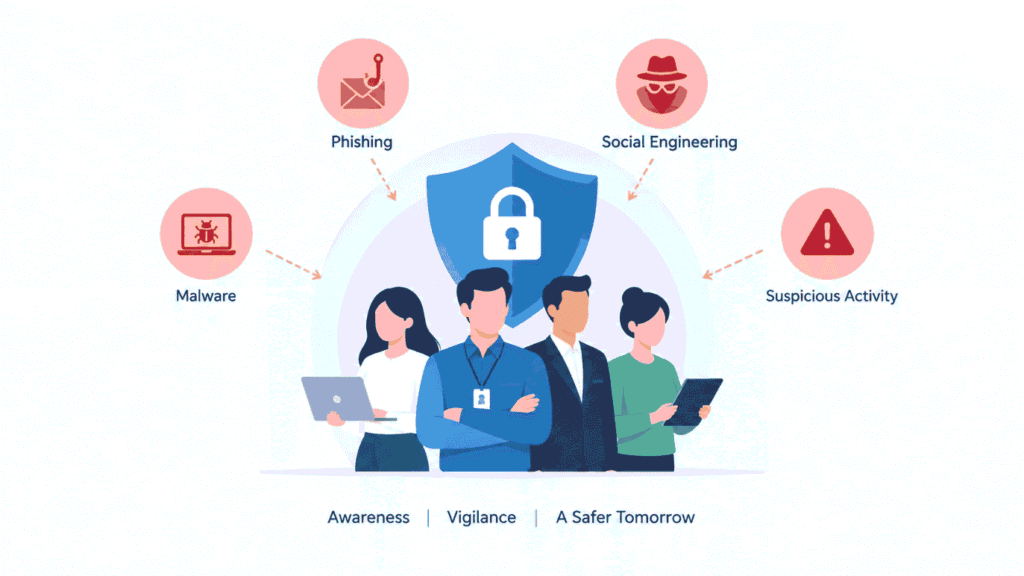
Why Human Behaviour Remains a Cybersecurity Risk
Modern attacks frequently exploit normal business activities rather than relying exclusively on technical vulnerabilities.
Employees routinely open attachments, follow links, approve requests, share files, access cloud applications, and communicate with external parties. Attackers imitate these familiar activities to make malicious requests appear legitimate.
A phishing email might resemble a Microsoft 365 notification. A message may claim that an executive needs an urgent payment completed. A telephone caller might impersonate technical support and request remote access to a workstation. A fraudulent supplier may send an invoice with modified banking information.
These attacks exploit trust, urgency, authority, curiosity, and routine.
The risk becomes greater when employees are under pressure, working quickly, handling unfamiliar requests, or unsure how to verify a message. Attackers may deliberately create urgency to discourage independent checks.
Security awareness helps employees recognize these pressure tactics and understand when normal business procedures must take priority over an apparently urgent request.
However, organizations should not treat every mistake as an individual failure. Confusing procedures, excessive workloads, unclear reporting channels, and poorly designed systems can also contribute to unsafe decisions. A mature security culture addresses these organizational conditions alongside employee knowledge.
Phishing Recognition: Identifying Suspicious Messages Before They Cause Damage
Phishing remains one of the most recognizable examples of social engineering because it uses electronic communication to persuade people to disclose information, open malicious content, or perform an action that benefits an attacker.
Messages may impersonate executives, banks, delivery services, cloud platforms, suppliers, or internal IT teams. Some contain obvious spelling errors or suspicious formatting, but more sophisticated attempts can closely resemble legitimate business communication.
Employees should learn to assess a message in context rather than relying on a single warning sign.
Unexpected requests for passwords, authentication codes, sensitive files, payments, or urgent account verification deserve particular attention. Users should examine the sender’s actual email address, consider whether the request matches normal business practice, and avoid assuming that a familiar display name proves authenticity.
Links and attachments also require caution. Employees should avoid opening unexpected files or entering credentials through links in unsolicited messages. When a message requests a sensitive action, they should verify it through a trusted channel rather than using contact details supplied in the suspicious communication.
Awareness training should include realistic examples of phishing, including targeted spear-phishing and business email compromise scenarios. Employees need to understand how these attacks exploit business relationships, not simply memorize a list of suspicious words.
Organizations can reinforce this knowledge through controlled phishing simulations. These exercises should be designed to identify learning opportunities, measure improvement, and help employees develop safer habits, not to embarrass or punish individuals.
Social Engineering: When Attackers Manipulate Trust
Social engineering extends beyond email. It involves manipulating people into revealing information, granting access, bypassing procedures, or taking actions that compromise security.
Attackers may use telephone calls, messaging applications, social media, video meetings, impersonation, or physical access attempts. They may research employees and business relationships to make their approach more convincing.
For example, an attacker might impersonate a senior manager and request confidential information before a meeting. Another might claim to be an external technician who needs an employee to approve a remote-access request. A caller could pretend to be a supplier dealing with an urgent payment issue.
Employees need a clear principle: a request should be verified according to its risk, not accepted solely because the person making it appears familiar, senior, or authoritative.
High-risk requests should follow established verification procedures. Payment changes should be confirmed through independently verified contact details. Requests for credentials or authentication codes should be treated with particular caution. Unusual access requests should be checked with the appropriate IT or security team.
Organizations should also establish clear procedures for visitors, physical access, information sharing, and external support personnel.
Training should help employees practice these decisions through realistic scenarios. Knowing that social engineering exists is not the same as being prepared to respond when a convincing request arrives during a busy working day.
Reporting Suspicious Activity: Turning Awareness Into Early Detection
Recognizing a potential threat is only part of the process. Employees must also know what to do next.
An employee may notice an unexpected login notification, a suspicious email, an unfamiliar authentication prompt, an unusual request for sensitive information, or a message that appears to come from a compromised colleague. If that employee ignores the warning or delays reporting it, the organization may lose valuable time.
A clear reporting process helps convert individual observations into actionable security information.
Employees should know where to report suspicious emails, unusual system behaviour, potential data exposure, lost devices, unexpected authentication requests, and possible policy violations. Reporting channels should be easy to find, accessible, and appropriate for the severity of the incident.
Organizations should also explain what happens after a report is submitted. Employees are more likely to participate when they understand that security teams review reports, provide feedback, and use the information to improve protection.
Equally important, employees should feel safe reporting mistakes. Someone who accidentally clicks a suspicious link must be encouraged to report the action promptly rather than hide it out of embarrassment or fear of punishment. Early disclosure can help security teams investigate, determine whether credentials or systems were affected, and take appropriate containment measures.
A strong reporting culture treats timely disclosure as a positive security behaviour. It recognizes that rapid reporting can make the difference between an isolated event and a more extensive incident.
Building a Security Culture Beyond Annual Training
Security awareness is most effective when it becomes part of everyday work rather than a separate compliance activity.
A one-time training session can introduce essential concepts, but it cannot guarantee that employees will remember or apply them months later. Threats change, job responsibilities differ, and people need opportunities to reinforce their knowledge through practical experience.
A sustainable awareness programme uses short learning sessions, periodic reminders, realistic scenarios, role-specific guidance, and clear communication from leadership. It reinforces a small number of important behaviours consistently instead of overwhelming employees with technical information.
Management participation is also essential. Employees are more likely to follow security procedures when leaders demonstrate the same behaviour. Executives should use approved communication channels, respect verification requirements, and support staff who pause an urgent request to confirm its legitimacy.
Organizations should tailor training to actual responsibilities. Finance teams may need additional guidance on payment fraud and supplier impersonation. Human resources personnel may handle sensitive employee records. IT administrators require focused training on privileged access, authentication abuse, and secure support practices. Customer-facing teams may need guidance on identity verification and information disclosure.
The objective is to make security relevant to the decisions employees actually make.
A healthy security culture also avoids treating awareness as a substitute for effective technology and processes. Employees should not be expected to compensate for confusing workflows, inadequate access controls, or missing technical safeguards. The strongest programmes combine informed behaviour with systems that make secure choices easier.
Measuring Security Awareness: From Training Completion to Behavioural Improvement
A completed training course does not necessarily demonstrate that employees can recognize or respond to real threats. Organizations need to evaluate whether awareness activities are improving security behaviour.
Useful measurements include phishing simulation outcomes, suspicious-message reporting rates, time taken to report simulated or real incidents, training assessment results, and recurring mistakes across departments. Organizations can also review whether employees follow verification procedures for sensitive requests and whether reporting channels are being used appropriately.
These indicators should be interpreted together.
For example, an increase in reported suspicious emails may indicate improved awareness rather than an increase in successful attacks. Similarly, a lower phishing simulation click rate can be encouraging, but it does not establish that employees can recognize telephone-based impersonation or fraudulent payment requests.
Metrics should therefore measure several stages of the response: whether employees recognize a risk, whether they avoid the unsafe action, whether they report the concern, and whether they follow the correct process.
Results can help identify areas requiring additional training. If a particular department repeatedly struggles with payment-related simulations, the organization can introduce targeted exercises and reinforce transaction-verification procedures.
Measurements should be used to improve the programme, not simply rank or shame employees. Clear objectives, consistent measurement methods, privacy-conscious reporting, and constructive feedback help maintain trust and encourage participation.
Over time, organizations can assess whether training is producing sustained improvements rather than short-lived changes immediately after a campaign.
The Role of Security Awareness in GCC Organizations
Organizations across Qatar and the GCC operate in increasingly connected business environments involving digital government services, financial operations, telecommunications, healthcare, cloud applications, industrial systems, and international supply chains.
Employees may communicate with customers and suppliers across multiple countries, access corporate systems remotely, and handle sensitive information through numerous channels. This creates opportunities for attackers to exploit familiar business processes and trusted relationships.
Security awareness should therefore reflect the organization’s industry, operating environment, applicable regulatory obligations, and specific threat exposure. Employees in financial services may require particular emphasis on payment fraud and data protection, while industrial organizations may need to reinforce secure remote access, incident reporting, and the protection of operational information.
Organizations should align awareness activities with internal security policies and applicable requirements rather than assuming that a generic training programme is sufficient.
For businesses seeking to strengthen their wider cybersecurity posture, awareness should complement technical capabilities such as threat monitoring, identity protection, incident response, and security governance. The human firewall is not an isolated control; it is one component of a coordinated security programme.
How CORVIT MSSP Supports Security Awareness
CORVIT MSSP recognizes the importance of addressing cybersecurity through both organizational readiness and technical protection. Security awareness helps employees understand their role in reducing everyday cyber risk, while the wider security programme helps organizations identify and manage threats across their environments.
CORVIT’s Security Awareness service is relevant to organizations seeking to strengthen employee understanding of cybersecurity risks and encourage safer everyday practices.
An effective awareness initiative should help employees recognize phishing and social engineering, protect credentials and sensitive information, follow verification procedures, and report suspicious activity through approved channels. It should also support ongoing learning through practical examples and measurable improvement.
Awareness works best when connected to the organization’s wider security operations. Employee reports can provide useful information for investigation, while incident findings can help identify where additional training or clearer procedures may be needed.
CORVIT’s broader MSSP portfolio includes security capabilities that complement organizational awareness, including its Cyber Defense Center (SOC) and Digital Forensics and Incident Response (DFIR) services. These capabilities address different parts of the security lifecycle: awareness supports safer decisions and reporting, monitoring helps identify suspicious activity, and incident response supports investigation and containment.
The precise combination of services should reflect each organization’s requirements, risks, and operating model. The goal is to create a security approach in which employees understand what to look for, know how to respond, and can work alongside technical security controls.
Conclusion
A strong human firewall helps employees recognise threats, report suspicious activity and make safer security decisions. Ongoing training, practical exercises and a supportive security culture help reduce cyber risk.
For organisations across Qatar and the GCC, CORVIT MSSP Security Awareness helps strengthen employee awareness and cybersecurity readiness.
Help your employees recognize risks before they become incidents.
Explore CORVIT MSSP Security Awareness to learn more about strengthening organizational cybersecurity awareness and readiness.
FAQs
1- What is a human firewall in cybersecurity?
A human firewall is a workforce trained to recognize common cyber threats, make safer security decisions, protect sensitive information, and report suspicious activity. It complements technical controls rather than replacing them.
2- How does security awareness reduce phishing risks?
Security awareness teaches employees to examine unexpected messages, recognize suspicious requests, verify links and attachments, and confirm sensitive actions through trusted channels. It also encourages prompt reporting when a message appears malicious.
3- What is the difference between security awareness and security training?
Security training typically teaches specific knowledge or skills, while security awareness focuses on maintaining an ongoing understanding of threats and encouraging secure behaviour. Effective programmes combine both.
4- How can an organization measure security awareness effectiveness?
Organizations can evaluate phishing simulation results, reporting rates, response times, assessment results, and adherence to verification procedures. These metrics should be assessed together to understand whether employee behaviour is improving.