

From Compliance to Continuous Security: The Changing GCC Cybersecurity Model
October 27, 2026Learn how CORVIT MSSP helps organisations reduce third-party cyber risk through supplier assessments, secure access, continuous monitoring and incident response.
Introduction
Organizations invest heavily in protecting their networks, applications, identities, and data. However, their security posture also depends on the external companies and service providers connected to their business operations.
Cloud providers host critical workloads. Managed service providers administer infrastructure. Software vendors supply business applications. Contractors access internal systems, while logistics partners, payment processors, and technology suppliers exchange sensitive information. Each relationship can introduce dependencies that extend beyond the organization’s direct control.
If a supplier experiences a security breach, attackers may use compromised credentials, vulnerable software, trusted integrations, or authorized remote access to reach downstream customers. Even when an organization’s internal controls are functioning as intended, a security failure elsewhere in its supply chain can create operational disruption, data exposure, financial loss, and reputational damage.
This is the challenge of third-party cyber risk.
The risk becomes more complex when suppliers depend on their own external providers, creating fourth-party and extended supply-chain exposure. A business may understand its direct relationship with a vendor without having sufficient visibility into the technology platforms, subcontractors, or infrastructure supporting that vendor’s services.
For organizations across Qatar and the wider GCC, where digital transformation connects enterprises, critical infrastructure, financial services, telecommunications, and government services, supplier security is an important component of business resilience.
The question is no longer simply, “Are our own systems secure?”
It is also, “Can we understand, manage, and respond to the cyber risks introduced by the organizations we depend on?”
What Is Third-Party Cyber Risk?
Third-party cyber risk is the possibility that a security weakness, incident, or failure involving an external organization could affect the confidentiality, integrity, or availability of another organization’s systems, information, or operations.
Third parties include technology vendors, cloud service providers, software developers, managed service providers, consultants, contractors, outsourced business-process providers, and other organizations with access to business data or infrastructure.
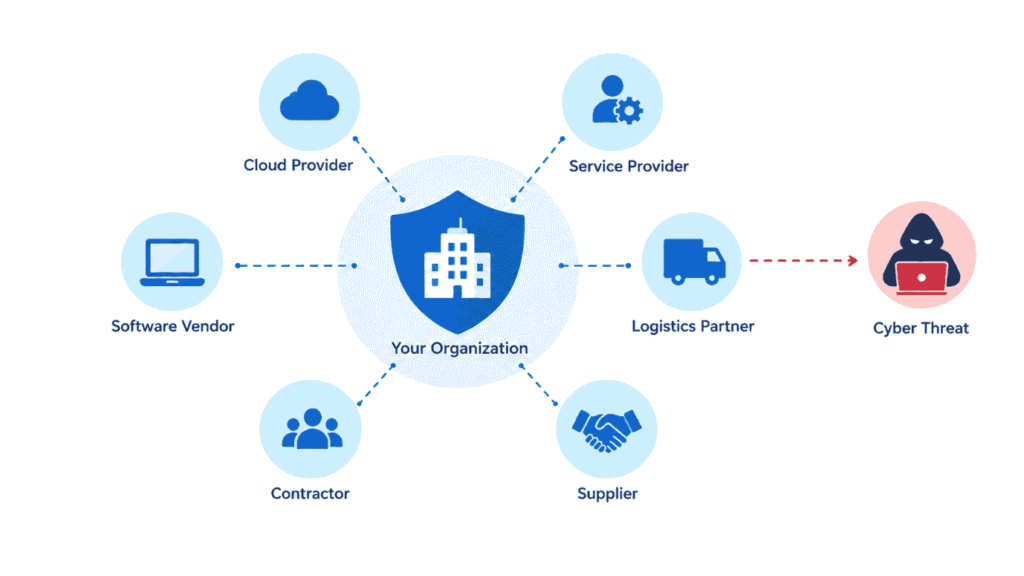
The level of risk depends on the nature of the relationship. A supplier that only delivers standard office materials may have limited access to sensitive systems. A managed service provider with privileged administrative access, however, may be capable of making changes across critical infrastructure.
Third-party risk can arise from several sources, including:
- Compromised vendor accounts or privileged credentials.
- Vulnerable or poorly maintained software.
- Inadequate security controls within a supplier’s environment.
- Unauthorized access to sensitive information.
- Insecure integrations, APIs, and remote connections.
- Supplier outages or ransomware incidents.
- Subcontractors with insufficient security oversight.
- Delayed notification or unclear incident responsibilities.
Effective management begins by identifying which external relationships could materially affect business operations and determining what protections are appropriate for each relationship.
Why Traditional Security Boundaries Are No Longer Enough
Traditional cybersecurity strategies often focus on systems directly owned and operated by an organization. Firewalls, endpoint protection, identity controls, and network monitoring help protect these environments, but external relationships can introduce additional paths into the business.
A supplier may connect through a remote-access gateway, maintain an integration with a business application, process customer records, or administer a cloud workload. These connections can create legitimate access pathways that attackers may attempt to exploit.
For example, if an attacker compromises a vendor’s administrative account, they may be able to use the account’s existing permissions to access systems belonging to the vendor’s customers. The activity may appear to originate from an authorized user, making it more difficult to distinguish malicious behaviour from legitimate administration.
Similarly, a compromised software update or vulnerable third-party component may introduce risk without requiring an attacker to breach the customer’s network perimeter directly.
This means organizations need to understand not only which security controls they operate, but also how external identities, systems, software, and connections interact with their environments.
A supplier relationship should therefore be treated as a potential extension of the organization’s attack surface, with controls proportionate to the access and business impact involved.
Supplier Security Assessments Must Reflect Actual Risk
Supplier assessments provide a structured way to understand whether external organizations have appropriate security practices for the services they deliver.
However, a questionnaire alone does not establish that a supplier is secure. Responses may become outdated, may not cover the specific service being provided, or may not adequately reflect the consequences of a compromise.
A more effective approach begins with supplier classification.
Organizations should identify which suppliers can access sensitive data, administer critical systems, connect to operational technology, support essential business services, or create significant operational dependencies. These relationships generally warrant greater scrutiny than low-impact suppliers.
Assessments should examine relevant areas such as identity and access management, multifactor authentication, vulnerability management, encryption, security monitoring, incident response, business continuity, subcontractor oversight, and data handling.
Evidence should be appropriate to the supplier’s risk profile. Depending on the relationship, this might include independent assurance reports, relevant certifications, security policies, penetration-testing summaries, incident-response procedures, or documented control assessments. A certification can provide useful assurance, but it should not be interpreted as proof that every service or integration is risk-free.
Organizations should also establish clear approval criteria. Significant gaps may require remediation commitments, additional safeguards, restricted access, or escalation to business and security leadership before the relationship proceeds.
Supplier assessments should not be treated as a procurement formality. They should inform actual decisions about access, contractual requirements, monitoring, and acceptable residual risk.
Vendor Access: Control the Connection, Not Just the Contract
One of the most important aspects of third-party cyber risk is the access vendors receive to organizational environments.
External engineers, support personnel, software providers, and managed service teams may need legitimate access to troubleshoot systems or deliver services. The security challenge is ensuring that this access is appropriately authorized, limited, monitored, and removed when no longer required.
Organizations should apply least-privilege principles so vendors receive only the permissions necessary to perform their assigned tasks. Separate accounts, multifactor authentication, controlled remote-access gateways, and privileged access management can help reduce the consequences of compromised credentials.
Access should be restricted by role, system, and business need. Where practical, sensitive administrative sessions should be approved, recorded, or monitored. Shared accounts should be avoided when they prevent reliable accountability.
Vendor access should also be time-bound wherever possible. Temporary access should expire when the task is complete, while ongoing access should be reviewed periodically. When a contract ends or personnel change, the organization must ensure that accounts, credentials, tokens, certificates, and other access mechanisms are revoked or updated as appropriate.
These controls become especially important when suppliers connect to critical business applications, cloud infrastructure, industrial networks, or systems that support essential services.
A signed contract establishes a business relationship. It does not, by itself, make the associated technical connection secure.
Fourth-Party Risk: Understanding Your Supplier’s Dependencies
Third-party risk rarely stops with the first supplier.
A cloud software provider may rely on an external hosting platform. A managed service provider may subcontract monitoring or support. A software vendor may incorporate open-source libraries and commercial components developed by other organizations. These dependencies introduce what is commonly called fourth-party risk.
The customer may have no direct contractual relationship with these downstream providers, yet a failure involving one of them could affect the service it receives.
Complete visibility into every layer of a complex supply chain may not always be practical. Organizations should therefore prioritize dependencies according to criticality, concentration, data sensitivity, and potential operational impact.
For critical suppliers, useful questions include: Which external services are essential to delivery? Where are sensitive data and workloads processed? Which subcontractors can access organizational information? What happens if a key provider becomes unavailable? Can the supplier explain how it manages security across its own supply chain?
Software supply-chain risk also deserves attention. Organizations should understand how suppliers manage software vulnerabilities, component updates, dependency risks, and security advisories. Where relevant, software bills of materials (SBOMs) can help provide visibility into software components, although an SBOM alone does not prove that a product is secure.
The objective is not to map every business relationship with equal intensity. It is to identify the dependencies capable of creating material risk and establish suitable assurance, contingency, and response arrangements.
Continuous Vendor Monitoring: Risk Changes After Onboarding
A supplier that meets security requirements during onboarding may not maintain the same risk profile indefinitely.
Its ownership may change, a critical vulnerability may emerge, its security team may experience disruption, or a new subcontractor may be introduced. Vendor access can also expand as business requirements change.
For this reason, supplier security cannot rely exclusively on an annual questionnaire or a review conducted before contract signing.
Continuous third-party risk management combines periodic reassessment with event-driven reviews and relevant security monitoring. Organizations can reassess critical suppliers when material changes occur, review access permissions regularly, track unresolved security findings, and monitor relevant vulnerability disclosures and incident notifications.
External attack-surface monitoring and threat intelligence may provide additional insight into exposed assets, suspicious infrastructure, or emerging threats associated with suppliers. These signals require context and validation: an exposed service or public vulnerability does not automatically establish that a supplier has been compromised.
Monitoring should connect to a defined decision-making process. When a significant concern is identified, the organization needs to know who validates it, who contacts the supplier, what temporary safeguards are available, and when the issue must be escalated.
Continuous monitoring is valuable because it turns supplier risk management from a static record of past assurances into an ongoing process for identifying changes that may affect business exposure.
Security Requirements and Contracts Must Be Enforceable
Technical safeguards are only part of supplier risk management. Contracts and service agreements should establish clear security responsibilities and provide a basis for accountability.
Requirements should reflect the service’s risk profile and may cover access controls, data protection, encryption, vulnerability remediation, security testing, subcontractor management, audit or assurance rights, business continuity, and incident notification.
Incident notification requirements are particularly important. Organizations need to understand how quickly a supplier must notify them of a suspected or confirmed incident that could affect their data, systems, or services. The agreement should clarify communication channels, information-sharing expectations, cooperation requirements, and responsibilities for regulatory or customer notifications where applicable.
Contracts should also address changes in service delivery, the introduction of material subcontractors, secure data return or deletion, and termination of access when a relationship ends.
Requirements must be realistic and verifiable. A clause that says a supplier must maintain “appropriate security” offers less operational clarity than defined controls, reporting obligations, review mechanisms, and remediation expectations.
Legal, procurement, business, and security teams should collaborate so that requirements are proportionate, enforceable, and aligned with applicable laws and regulatory obligations. Contractual protections do not eliminate technical risk, but they help establish the processes needed to manage it.
Incident Coordination Across Organizational Boundaries
When a supplier experiences a cyber incident, delays in communication can increase uncertainty and extend the impact on dependent organizations.
A customer may need to determine whether its data was exposed, whether vendor credentials remain trustworthy, whether integrations should be disabled, or whether critical services can continue operating. The supplier may simultaneously be investigating the incident and managing its own recovery.
Without agreed procedures, both organizations may struggle to identify decision-makers, exchange relevant evidence, or coordinate containment actions.
Incident coordination should therefore be established before an incident occurs. Organizations should maintain current supplier contacts, define escalation paths, document responsibilities, and determine how security information will be shared. Critical suppliers should understand which events require immediate notification and what information the customer needs to assess exposure.
Response planning should consider practical actions such as revoking compromised vendor credentials, suspending affected integrations, restricting remote access, validating the integrity of delivered software, and identifying alternative arrangements for essential services. These actions should be assessed carefully because abruptly disabling a supplier connection can itself disrupt operations.
Exercises involving internal teams and critical suppliers can help identify gaps in communication and decision-making. After an incident, both parties should review what happened, address contributing weaknesses, and update controls or procedures.
The objective is to establish a coordinated response that protects the organization while recognizing that suppliers and customers may have different operational responsibilities.
Third-Party Risk and Regulatory Expectations in the GCC
Organizations across Qatar, Saudi Arabia, the UAE, Bahrain, Kuwait, and Oman operate within different regulatory and sector-specific environments. Depending on the organization and service involved, requirements may address data protection, outsourcing, cloud services, critical infrastructure, business continuity, and cybersecurity governance.
Third-party risk management should therefore be integrated into enterprise risk management and compliance processes. Organizations need to identify which obligations apply to their activities, determine how suppliers affect compliance, and maintain appropriate evidence of oversight.
For critical services, this may include documented risk assessments, approved supplier inventories, access reviews, incident coordination procedures, and evidence that material risks are being addressed. Organizations operating across multiple GCC jurisdictions should avoid assuming that one set of contractual or assessment requirements automatically satisfies every applicable obligation.
Supplier risk is also a business continuity concern. A cyber incident involving an external provider can affect customer services, payment processing, industrial operations, communications, and access to business-critical data.
For this reason, supplier resilience should be evaluated alongside supplier security. Organizations should understand which dependencies are difficult to replace, how long disruption can be tolerated, and what contingency arrangements exist if a critical provider becomes unavailable.
How CORVIT MSSP Supports a Stronger Third-Party Security Posture
Managing third-party cyber risk requires coordinated governance, supplier oversight, controlled access, security monitoring, and incident response. No single technology or security service can replace the organization’s responsibility to assess suppliers and establish appropriate contractual requirements.
CORVIT MSSP provides broader managed cybersecurity capabilities that can support the technical security and monitoring aspects of this approach.
CORVIT’s Cyber Defense Center (SOC) supports security monitoring and investigation, helping organizations identify suspicious activity across relevant monitored environments. When vendor accounts, remote connections, or integrated systems are within monitoring scope, security teams can use available telemetry to investigate potentially unauthorized activity.
Threat Intelligence can help provide context about emerging threats, malicious infrastructure, and relevant indicators that may inform security investigations. This information can complement supplier assessments and risk reviews, but it does not independently certify a supplier’s security posture.
CORVIT’s Zero Trust, SASE and SSE capabilities are also relevant to organizations seeking stronger control over access to applications and business resources. Access policies should be designed around verified identities, device and connection context, least privilege, and the organization’s operational requirements.
If a third-party-related incident requires investigation and containment, Digital Forensics and Incident Response (DFIR) can support the incident-response process, subject to the agreed service scope and available evidence.
These capabilities complement, rather than replace, supplier classification, due diligence, contractual controls, fourth-party oversight, and coordinated incident planning.
Explore the wider CORVIT MSSP portfolio to understand how managed security capabilities can contribute to a broader organizational defense strategy.
Conclusion
Third-party cyber risk can affect data security, business continuity and supply chain resilience. Managing it requires risk-based supplier assessments, secure vendor access, continuous monitoring and clear incident-response procedures.
For GCC organisations, CORVIT MSSP supports broader cybersecurity efforts through security monitoring, threat intelligence, access protection and incident response.
Your security depends not only on the controls you operate, but also on the risks you understand and manage across your business relationships.
Strengthen your wider cybersecurity posture with CORVIT MSSP: https://corvit.com/networks/mssp/
FAQs
1- What is third-party cyber risk?
Third-party cyber risk is the possibility that a supplier, contractor, service provider, or other external organization could expose a business to cyber incidents, data loss, unauthorized access, or operational disruption.
2- What is the difference between third-party and fourth-party risk?
Third-party risk concerns an organization’s direct suppliers. Fourth-party risk concerns the suppliers, subcontractors, and service providers that those direct suppliers rely on. Both can affect the organization’s security and continuity.
3- How can organizations reduce risks from vendor access?
Organizations can apply least privilege, multifactor authentication, controlled remote access, separate vendor accounts, privileged-session monitoring, periodic access reviews, and timely revocation of unnecessary permissions.
4- How can an MSSP support third-party cyber risk management?
An MSSP can support related technical activities through security monitoring, threat intelligence, access protection, and incident response. These capabilities complement supplier assessments, contractual governance, and the organization’s own third-party risk management responsibilities.