
Why Threat Detection Alone Isn’t Enough: The Need for Continuous Threat Hunting
September 23, 2026
From Vulnerability to Exploitation: How Attackers Turn Security Gaps Into Breaches
October 6, 2026Discover how modern SOCs reduce alert overload through AI, threat intelligence, threat hunting, and faster incident response.
Introduction
Cybersecurity teams are no longer struggling with a lack of security data. In many organizations, the problem is the opposite: too much data and too little time to determine what actually matters.
Modern enterprises generate security events across endpoints, networks, cloud environments, applications, identities, email systems, and security controls. Every event can potentially represent a threat, but not every alert represents an actual attack. When security analysts face thousands of notifications, investigations can slow, become inconsistent, and get hard to prioritize.
This is where the modern Security Operations Center (SOC) is evolving.
A mature SOC is no longer simply a monitoring function that waits for alerts. It is becoming an integrated cyber defense capability that combines continuous monitoring, Security Information and Event Management (SIEM), Extended Detection and Response (XDR), Network Detection and Response (NDR), threat intelligence, behavioral analytics, threat hunting, automation, and expert investigation.
The objective is not to generate more alerts.
The objective is to turn security signals into informed decisions and rapid action.
For organizations operating complex IT, cloud, telecom, and OT environments, this transformation is particularly important. Modern Managed Security Services Provider (MSSP) models can provide the technology, expertise, and 24/7 operational capability required to move from reactive alert management toward proactive cyber defense. CORVIT MSSP, for example, combines a 24/7 Cyber Defense Center with AI-assisted analytics, threat intelligence, EDR/XDR, NDR, threat hunting, and incident response capabilities.
Why Alert Overload Has Become a Cybersecurity Problem
Security alerts are essential because they provide indications of potentially malicious activity. The challenge begins when security teams receive more alerts than they can effectively investigate.
A single suspicious login might generate one alert. An endpoint compromise could generate dozens. A coordinated attack involving identity, endpoint, network, cloud, and application activity could generate hundreds or thousands of related events.
Without effective correlation and prioritization, analysts may struggle to determine:
- Which alerts represent genuine threats
- Which events are related to the same attack
- Which systems are actually compromised
- Whether an attacker has moved laterally
- What the potential business impact is
- Which incident requires immediate response
This creates alert fatigue.
CORVIT specifically identifies alert fatigue, limited visibility, hidden threats, and evolving attacker techniques as challenges that make proactive threat hunting increasingly important.
The result is a fundamental shift in SOC priorities:
- From: “How many alerts did we process?”
- To: “Which threats matter, and what should we do about them?”
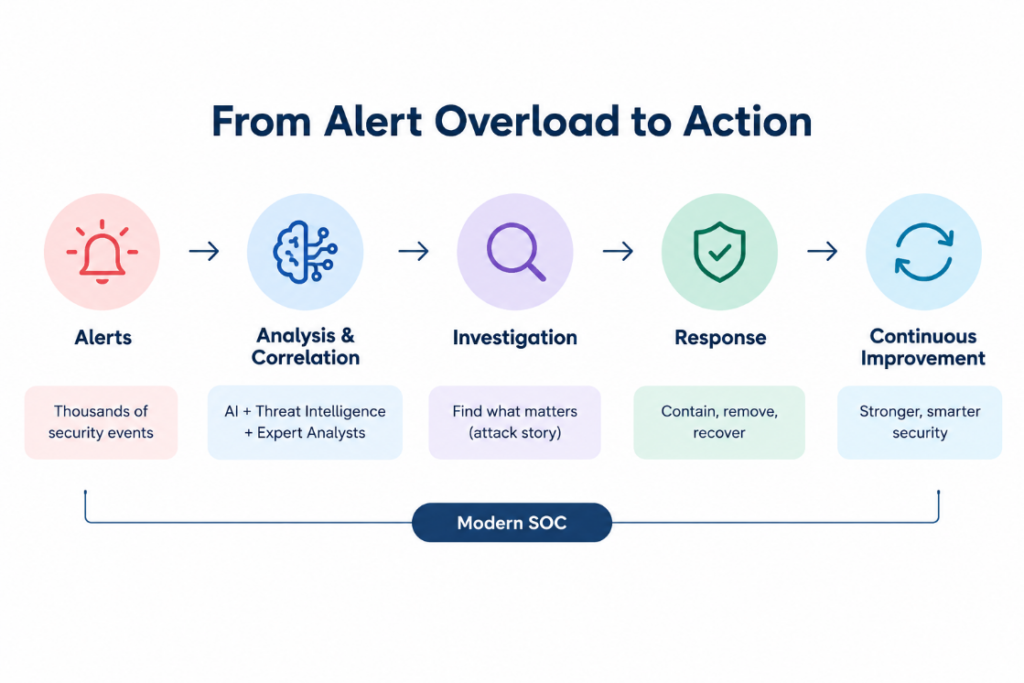
What Is a Modern Security Operations Center?
A traditional SOC primarily focused on monitoring security events and escalating suspicious activity.
A modern Security Operations Center (SOC) operates more like an intelligence-driven cyber defense function.
It continuously collects and analyzes telemetry from:
- Endpoints
- Servers
- Networks
- Firewalls
- Cloud environments
- Applications
- Identity systems
- Email platforms
- Security appliances
- OT and IoT environments
The data is then enriched with threat intelligence, correlated across multiple sources, analyzed using behavioral techniques, and investigated by security professionals.
CORVIT’s Cyber Defense Center provides 24/7 monitoring, integrated threat intelligence, AI-assisted threat analysis, and expert incident response as part of its managed security model.
A modern SOC therefore connects several capabilities:
Collect → Correlate → Prioritize → Investigate → Respond → Hunt → Improve
This creates a continuous security cycle rather than a simple alert queue.
From Individual Alerts to Attack Stories
One of the biggest transformations in modern SOC operations is the movement from event-based detection to incident-based analysis.
Consider a simple example.
An organization receives:
- A suspicious login alert
- An endpoint malware alert
- An unusual PowerShell execution event
- An abnormal internal network connection
- An unexpected privileged-account action
Individually, these events may appear unrelated.
A modern SOC can correlate them into a broader attack sequence:
Compromised credentials → Initial access → Endpoint execution → Lateral movement → Privilege escalation
This changes the analyst’s perspective.
Instead of investigating five separate alerts, the SOC investigates one potential attack campaign.
That context can significantly improve investigation efficiency and help analysts understand attacker behavior rather than simply responding to individual technical events.
The Role of SIEM in Modern SOC Operations
Security Information and Event Management (SIEM) remains an important foundation for many SOC environments.
SIEM platforms centralize security logs and events from different systems, allowing analysts to search, correlate, investigate, and retain security information.
A modern SOC can use SIEM capabilities to establish broad visibility across:
- Authentication activity
- Firewall events
- Server logs
- Application activity
- Cloud services
- Endpoint telemetry
- Network infrastructure
- Security controls
However, SIEM should not be viewed as a complete SOC strategy.
Large-scale log collection can create enormous volumes of data. Without effective rules, correlation, analytics, enrichment, and investigation processes, the organization can simply move from fragmented alerts to a centralized alert backlog.
The modern approach therefore combines SIEM with other technologies and human expertise.
Why XDR Is Changing Security Operations
Extended Detection and Response (XDR) extends detection and investigation beyond a single security layer.
Instead of analyzing endpoint activity independently, XDR can correlate signals across multiple security domains, depending on the platform and integrations available.
These can include:
- Endpoint
- Identity
- Network
- Cloud
- Applications
This cross-domain visibility helps SOC analysts identify relationships between events.
For example, a phishing email, suspicious login, endpoint process execution, and unusual network connection could potentially be analyzed as components of the same incident.
XDR can therefore help organizations move from isolated detection toward cross-domain incident analysis and response.
CORVIT’s MSSP portfolio includes EDR/XDR alongside NDR, threat intelligence, SOC operations, and incident response capabilities, allowing detection and response functions to work as part of a broader security ecosystem.
Why NDR Matters When Attackers Move Inside the Network
Endpoint telemetry is valuable, but it does not provide complete visibility into everything happening across a network.
Attackers who successfully gain access may attempt to:
- Discover internal systems
- Move laterally
- Establish command-and-control communications
- Access additional credentials
- Reach sensitive systems
- Exfiltrate data
This is where Network Detection and Response (NDR) becomes particularly valuable.
CORVIT’s AI-Driven NDR uses AI-based behavioral analytics to monitor network traffic and identify suspicious activity such as lateral movement, command-and-control communication, and abnormal network behavior.
NDR can provide another critical layer of visibility to the SOC:
- Endpoint tells the SOC what is happening on systems.
- NDR helps reveal what is happening between systems.
Together, these perspectives can provide a much stronger understanding of an attack.
AI Is Helping SOCs Prioritize What Matters
Artificial intelligence is increasingly becoming part of modern security operations, but its most valuable role is not simply generating more detections.
Its value comes from helping analysts process complexity at machine speed.
AI-assisted security operations can support:
- Behavioral anomaly detection
- Event correlation
- Alert prioritization
- Threat classification
- Investigation assistance
- Threat intelligence correlation
- Detection of unusual patterns
- Response recommendations
CORVIT’s Cyber Defense Center incorporates AI-assisted threat analysis, while its Threat Intelligence service uses AI-powered correlation to connect global threat intelligence with organizational security events.
This creates an important operating model:
- AI processes scale.
- Security analysts provide judgment.
The objective is not to remove humans from the SOC. It is to allow analysts to spend less time manually processing repetitive events and more time investigating meaningful threats.
Threat Intelligence Turns Alerts Into Context
An alert becomes more valuable when the SOC understands why it matters.
Threat intelligence provides contextual information about:
- Threat actors
- Malware
- Indicators of compromise
- Malicious infrastructure
- Attack techniques
- Vulnerabilities
- Emerging campaigns
For example, an unusual IP address might initially appear to be a low-priority network event.
If threat intelligence identifies that infrastructure as associated with a known malicious campaign, its priority changes immediately.
CORVIT’s Threat Intelligence service uses StrikeReady technology to correlate global threat intelligence with organizational security events and provide actionable insights for security teams.
This transforms threat intelligence from a static information feed into an operational security capability.
From Threat Detection to Threat Hunting
Even the best detection technologies cannot identify every threat automatically.
Sophisticated attackers may use legitimate credentials, built-in administrative tools, unusual execution paths, or low-and-slow techniques designed to avoid traditional security controls.
This is why modern SOCs increasingly incorporate Threat Hunting.
Threat hunting is a proactive process in which security teams actively search for suspicious behaviors, indicators of compromise, and attack patterns that may not have generated a conventional alert.
CORVIT Threat Hunting searches across networks, endpoints, and cloud environments using advanced analytics, threat intelligence, behavioral detection, and expert investigation.
The relationship can be summarized simply:
- Detection asks: “Did our controls identify something suspicious?”
- Threat hunting asks: “What could be inside our environment that our controls have not identified yet?”
That difference is critical for proactive defense.
The Modern SOC Is Built Around a Continuous Security Cycle
A mature SOC should not treat an incident as the end of an investigation.
Every investigation should generate knowledge that improves future detection and response.
A simple model is:
Threat Intelligence → Detection → Investigation → Response → Threat Hunting → Detection Improvement → Repeat
Automation Helps Move From Alert to Action
Manual response can become a significant bottleneck when security teams face high alert volumes.
Modern SOCs can automate appropriate actions such as:
- Enriching alerts with threat intelligence
- Grouping related events
- Assigning risk scores
- Isolating compromised endpoints
- Blocking malicious indicators
- Disabling compromised accounts
- Escalating critical incidents
- Triggering investigation workflows
Automation should not mean blindly allowing machines to make every security decision.
High-risk actions should remain subject to appropriate policies, controls, and human oversight.
The objective is to automate speed and repetition, while analysts retain responsibility for context and judgment.
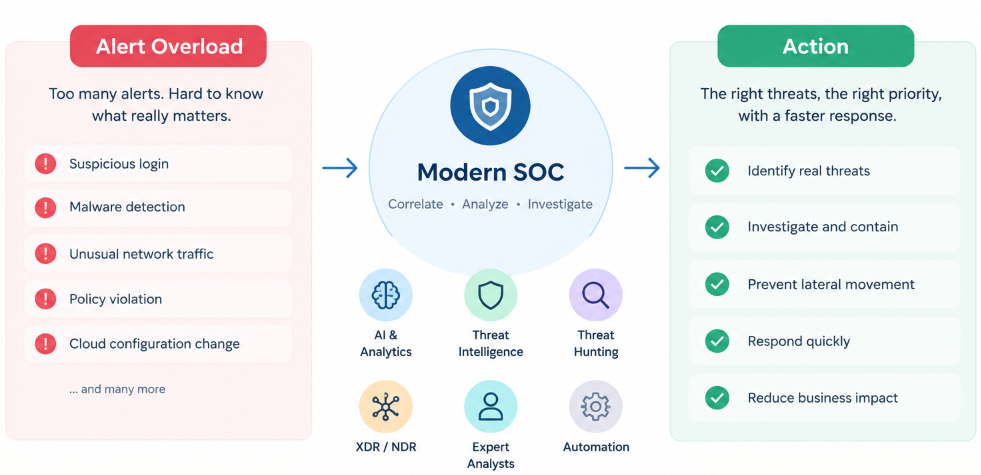
Incident Response Completes the Detection-to-Action Process
Detection has limited value if an organization cannot respond effectively.
When a significant incident is identified, the SOC needs a structured process for:
- Validating the incident
- Determining scope
- Containing the threat
- Investigating affected systems
- Removing attacker persistence
- Recovering affected services
- Identifying root cause
- Improving defenses
This is where Digital Forensics & Incident Response (DFIR) becomes an important extension of SOC operations.
CORVIT’s DFIR capability focuses on rapid threat containment, forensic investigation, compliance-ready investigation, and reducing business downtime following security incidents.
A mature SOC therefore connects detection directly to response rather than treating the two as separate functions.
Why This Matters for GCC Organizations
Organizations across the GCC are rapidly expanding cloud adoption, digital services, interconnected infrastructure, remote access, and data-driven business operations.
This creates a broader attack surface that extends across:
Users + Identity + Endpoints + Networks + Applications + Cloud + Data + OT
For critical infrastructure, financial services, telecommunications, healthcare, government, and large enterprises, a delayed response can create operational, financial, regulatory, and reputational consequences.
A modern SOC therefore needs to provide more than continuous monitoring.
It needs to provide continuous security decision-making.
CORVIT’s MSSP model is designed around this broader approach, combining protection, detection, response, recovery, and continuous security improvement through an integrated managed security ecosystem and 24/7 Cyber Defense Center.
How CORVIT MSSP Transforms Alerts Into Action
CORVIT MSSP combines managed cybersecurity technologies with expert security operations to help organizations move beyond reactive alert management.
Its integrated capabilities include:
- 24/7 Cyber Defense Center (SOC) for continuous monitoring, threat analysis, and response
- EDR/XDR for endpoint detection and response
- AI-Driven NDR for network behavior analysis and lateral movement detection
- Threat Intelligence for contextual and actionable intelligence
- Threat Hunting for proactively identifying hidden threats
- Identity Threat Detection & Response (ITDR) for identity-focused attacks
- Digital Forensics & Incident Response (DFIR) for investigation and containment
- Cloud Security for protecting cloud workloads and infrastructure
Together, these capabilities support a security lifecycle that moves from visibility to intelligence, detection to investigation, and investigation to response.
The goal is not to eliminate every security alert.
The goal is to ensure that important alerts do not become lost in the noise.
Conclusion
Modern cybersecurity cannot be measured simply by how many alerts a security team receives or how many dashboards a SOC operates. The real measure is how effectively an organization can identify meaningful threats, understand the attack behind the signal, prioritize risk, investigate suspicious activity, respond quickly, and continuously improve its defenses. Modern SOCs are transforming cyber defense by combining SIEM, XDR, NDR, AI-assisted analytics, threat intelligence, threat hunting, automation, and expert incident response into one continuous security operation. As attackers become faster and more adaptive, organizations need to move from alert management to threat-driven action—turning overwhelming volumes of security data into decisions that protect systems, identities, applications, data, and business operations.
From Alert Overload to Cyber Defense
Security teams should not have to choose between investigating every alert and missing the threats that matter.
CORVIT MSSP helps organizations turn security signals into actionable intelligence, proactive threat detection, rapid response, and continuous cyber defense.
Strengthen the SOC. Reduce alert overload. Turn detection into action: https://corvit.com/networks/mssp/
FAQs
1- What does a modern SOC do?
A modern SOC continuously monitors security environments, correlates events, investigates threats, uses threat intelligence and analytics, hunts for hidden threats, and coordinates incident response.
2- Is SIEM enough for a modern SOC?
SIEM provides important centralized visibility and event correlation, but modern SOCs often combine SIEM with XDR, NDR, threat intelligence, behavioral analytics, threat hunting, automation, and expert investigation.
3- How does AI help a SOC?
AI can help correlate large volumes of security data, identify behavioral anomalies, prioritize alerts, enrich investigations, and support faster response. Human analysts remain important for context, decision-making, and complex investigations.
4- Why is 24/7 SOC monitoring important?
Cyberattacks can occur outside normal business hours. A 24/7 SOC provides continuous monitoring and enables organizations to identify and respond to suspicious activity without relying solely on an internal team being available at a particular time.