

From Alert Overload to Action: How Modern SOCs Are Transforming Cyber Defense
September 29, 2026From vulnerability to exploitation, discover how attackers turn security gaps into breaches through initial access, lateral movement, and data theft.
Introduction
Every organization has security weaknesses. Some are known vulnerabilities in software or hardware, while others are created by misconfigurations, excessive privileges, exposed services, outdated systems, weak authentication, or incomplete security visibility. The existence of a vulnerability, however, does not automatically mean that a breach will occur. The real danger begins when an attacker discovers that weakness, determines that it can be exploited, and successfully turns it into a pathway toward valuable systems, identities, applications, or data.
This progression can be represented simply as:
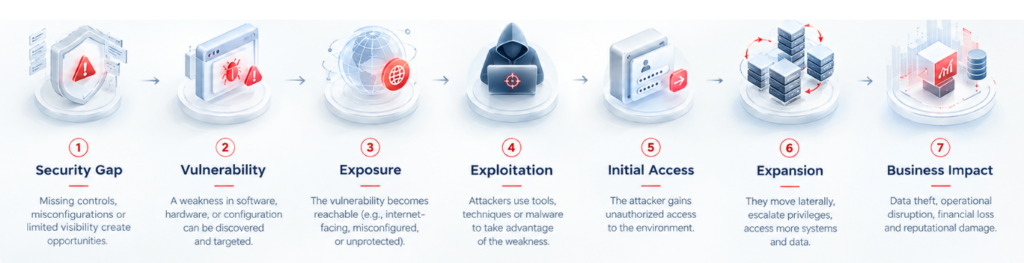
Understanding this progression is becoming increasingly important because attackers are moving faster. Verizon’s 2026 Data Breach Investigations Report found that vulnerability exploitation accounted for 31% of breaches in its dataset, making it the leading initial-access vector for the first time in the report’s history. Verizon also noted that AI is helping attackers accelerate activities associated with vulnerability exploitation.
The time available to defenders can also be extremely limited. CrowdStrike reported that during the first half of 2026, 88% of the vulnerability exploitation it observed involving a publicly available proof of concept occurred within 48 hours of the PoC’s release. In some cases, exploitation began within 24 hours.
This changes the cybersecurity question.
Organizations can no longer focus only on whether vulnerabilities exist. They must also understand which weaknesses are exposed, which affect critical assets, which are actively being targeted, and whether their security controls can detect and contain exploitation.
The objective is therefore not simply to eliminate vulnerabilities. It is to make it significantly harder for attackers to convert vulnerabilities into successful breaches.
What Is the Difference Between a Security Gap, Vulnerability, and Exploit?
The terms security gap, vulnerability, and exploit are often used together, but they describe different parts of the attack chain.
A security gap is a weakness or deficiency in an organization’s overall security capability. It could be a lack of network segmentation, incomplete asset visibility, weak access controls, inadequate monitoring, insufficient backup protection, or an ineffective incident response process. A security gap does not necessarily involve a software flaw; it can exist because an important security control is missing or improperly implemented.
A vulnerability is a specific weakness in software, hardware, configuration, architecture, or another technology component that could potentially be abused. Vulnerabilities may involve remote code execution, authentication weaknesses, privilege escalation, insecure configurations, vulnerable applications, exposed interfaces, or other technical weaknesses.
An exploit is the technique or mechanism used to take advantage of a vulnerability.
This distinction is important because a vulnerability represents potential exposure, while exploitation represents an attempt to turn that exposure into unauthorized activity.
The progression therefore looks like this:
- Vulnerability = Weakness
- Exploit = Method of abusing the weakness
- Breach = Successful unauthorized access or compromise
The security challenge is to interrupt this progression as early as possible.
How a Vulnerability Becomes an Attack Path
A vulnerability becomes significantly more concerning when it is exposed to an attacker and connected to something valuable.
Consider an internet-facing application containing a remotely exploitable vulnerability. The vulnerability may initially exist as a technical weakness, but once an attacker can reach the affected service, the situation changes. If exploitation succeeds, the attacker may obtain an initial foothold. From there, they may attempt to discover other systems, obtain credentials, escalate privileges, move laterally, or access sensitive information.
The attack therefore does not necessarily end with exploitation.
In many cases, exploitation is simply the first major step in a longer attack chain:
Exposed Asset → Exploitation → Initial Access → Persistence → Privilege Escalation → Lateral Movement → Data or Operational Impact
This is why vulnerability management should not operate separately from security monitoring and incident response. Security teams need to understand not only where weaknesses exist, but also whether those weaknesses are being targeted and what happens after an attacker gains access.
The First Problem: Security Gaps Create Opportunities
Attackers begin with opportunities, and modern organizations provide more potential opportunities than ever before.
Enterprise environments now span data centers, cloud platforms, SaaS applications, APIs, remote-access systems, endpoints, network infrastructure, development environments, third-party services, IoT devices, and operational technology. Each component introduces its own security requirements and potential exposure.
A security team may successfully protect one environment while having limited visibility into another. A newly deployed cloud workload may introduce an exposed service. A firewall configuration change may unintentionally create external access. A forgotten server may continue running outdated software. A third-party connection may create an unexpected pathway into an internal environment.
The challenge is therefore not simply finding vulnerabilities. It is maintaining accurate visibility of the environment in which those vulnerabilities exist.
An unknown asset can contain an unknown vulnerability, and an unknown vulnerability can become an unknown attack path.
Exposure Determines How Valuable a Vulnerability Is to an Attacker
Not every vulnerability presents the same practical risk.
A vulnerability on an isolated internal system is different from the same vulnerability affecting an internet-facing application. Similarly, a weakness on a non-critical endpoint has a different potential impact from a vulnerability affecting an identity platform, security appliance, cloud control plane, or business-critical application.
Exposure can depend on whether the system is externally reachable, whether authentication is required, what privileges the affected service has, whether it connects to other critical systems, and whether additional security controls can limit exploitation.
This is why organizations increasingly need to think beyond vulnerability severity alone.
The important question is not only:
“How severe is this vulnerability?”
It is also:
“Can an attacker reach it, exploit it, and use it to reach something important?”
Threat context can further change the priority. CISA’s Known Exploited Vulnerabilities Catalog is specifically intended to help organizations prioritize vulnerabilities known to have been exploited in real-world attacks.
This moves vulnerability management closer to exposure-aware cybersecurity.
Attackers Are Moving Faster From Disclosure to Exploitation
One of the most significant changes in the modern threat environment is the shrinking window between vulnerability disclosure and exploitation.
Historically, organizations often had time to assess a newly disclosed vulnerability, determine whether they were affected, test a patch, and schedule remediation. That window can now be dramatically shorter.
CrowdStrike reported that 88% of the exploitation it observed involving vulnerabilities with public proof-of-concept code during the first half of 2026 occurred within 48 hours of PoC release. It also documented threat activity beginning within 24 hours of disclosure in some cases.
This creates a difficult operational problem for organizations because immediate patching is not always possible. Critical applications may require testing, industrial systems may have strict maintenance windows, and legacy platforms may depend on vendor-specific processes.
When immediate remediation is not possible, organizations may need additional protective measures such as network segmentation, access restrictions, application isolation, increased monitoring, or other compensating controls.
The important principle is that a vulnerability awaiting remediation should not become an unmonitored vulnerability.
Exploitation Is Only the Beginning
Successful exploitation may provide an attacker with an initial foothold, but attackers often have broader objectives.
After entering the environment, an attacker may attempt to understand the systems they have reached, identify available accounts and services, locate sensitive information, and determine how to expand their access.
This is where the difference between vulnerability management and continuous cyber defense becomes particularly important.
A vulnerability management system may identify a vulnerable application. A security operations capability must determine whether someone is attempting to exploit that application, whether the attempt succeeded, what happened afterward, and whether additional systems have been affected.
The focus therefore shifts from simply managing vulnerabilities to understanding attack behavior.
Privilege Escalation Can Turn Limited Access Into Wider Compromise
An initial foothold does not necessarily provide an attacker with access to the most valuable resources. Attackers may therefore attempt to obtain higher privileges or compromise accounts with broader permissions.
Identity has become an important part of this process because attackers can potentially use compromised credentials to operate through legitimate authentication mechanisms.
A compromised identity can sometimes provide access without requiring the attacker to deploy obvious malware. Once authenticated, malicious activity may resemble legitimate user behavior, making detection more challenging.
For this reason, organizations need security visibility across both technology and identity. Endpoint activity, authentication events, privileged account behavior, cloud access, and unusual administrative activity can provide important signals when investigated together.
Identity security, least privilege, strong authentication, and continuous monitoring should therefore complement vulnerability management rather than operate as separate security initiatives.
Lateral Movement Expands the Attack
Once attackers establish access, they may attempt to move from the initially compromised system toward more valuable assets.
For example, an attack could potentially progress from an internet-facing application to an internal server, then toward identity infrastructure, databases, file systems, or critical business applications.
This is where network segmentation and behavioral visibility become important.
Strong segmentation can limit unnecessary communication between systems and reduce the number of pathways available to an attacker. Network monitoring can provide additional visibility into unusual connections, unexpected communication patterns, and other indicators of lateral movement.
Technologies such as Network Detection and Response can complement endpoint and identity telemetry by helping security teams understand what is happening across the network after an initial compromise.
The objective is not only to detect the first intrusion, but to prevent that intrusion from becoming an organization-wide security incident.
Threat Intelligence Helps Identify Which Vulnerabilities Matter
Vulnerability management becomes more effective when security teams understand the threat environment surrounding a vulnerability.
Threat intelligence can provide information about active exploitation, threat actors, attack campaigns, malicious infrastructure, indicators of compromise, attacker techniques, and emerging vulnerabilities.
This context can help organizations prioritize vulnerabilities according to their actual threat exposure rather than relying exclusively on generic severity ratings.
CORVIT’s Threat Intelligence capability is designed to connect external threat intelligence with organizational security visibility, helping security teams turn threat information into actionable security decisions.
Threat Hunting Looks for What Automated Detection May Miss
Even strong preventive controls and detection technologies cannot guarantee that every attack will generate an obvious alert.
Attackers may use legitimate credentials, administrative tools, cloud services, or other trusted mechanisms to blend into normal activity.
This is where proactive threat hunting becomes valuable.
CORVIT’s Threat Hunting capability can help investigate suspicious behavior across network, endpoint, and cloud environments. Threat hunters can examine unusual authentication activity, suspicious processes, abnormal network communication, privilege escalation, persistence, lateral movement, and other behaviors that may indicate compromise.
Threat hunting changes the question from:
“What alerted us?”
to:
“Could something already be happening that our existing detection rules have not identified?”
That distinction is particularly important when attackers are exploiting newly disclosed vulnerabilities before organizations have had time to fully remediate them.
24/7 Detection Helps Reduce the Time Between Exploitation and Response
A vulnerability can be exploited at any time.
An attack does not need to wait for office hours, a security team’s morning meeting, or the next scheduled vulnerability scan.
This is why continuous security monitoring is an important layer between vulnerability exploitation and business impact.
CORVIT’s Cyber Defense Center (SOC) provides 24/7 monitoring and security visibility across environments, supported by security technologies and expert analysis.
When vulnerability exploitation is suspected, continuous monitoring can help security teams investigate related endpoint, network, application, and identity activity.
The objective is to reduce the time between:
Exploitation → Detection → Investigation → Containment
The shorter this window becomes, the fewer opportunities an attacker has to expand the compromise.
EDR/XDR and NDR Help Reveal the Attack Path
Understanding the original vulnerability is important, but understanding what happened afterward is equally important.
EDR/XDR capabilities can provide visibility into endpoint and cross-environment activity, helping security teams investigate suspicious processes, connections, authentication behavior, and other indicators associated with compromise.
Similarly, CORVIT’s AI-Driven NDR capability can provide network-level visibility and help identify abnormal communication patterns.
Together, these capabilities can help answer critical questions:
- Was exploitation successful?
- Which system was compromised?
- Did the attacker establish persistence?
- Did suspicious communication occur afterward?
- Did the attacker move to another system?
- Was sensitive data accessed?
This is the difference between knowing that a vulnerability exists and understanding how an attacker attempted to use it.
Incident Response Must Address More Than the Original Vulnerability
When exploitation is detected, the priority shifts from prevention to containment and investigation.
Security teams need to determine how the attacker gained access, when the activity started, which systems were affected, whether credentials were compromised, and whether persistence mechanisms remain active.
CORVIT’s Digital Forensics & Incident Response capability supports investigation and response when organizations need to understand the scope and nature of an incident.
Effective response should address both the immediate threat and the original cause.
Simply removing an attacker from one system is not enough if the underlying vulnerability remains exposed or similar systems contain the same weakness.
The incident should therefore result in a complete security review of the attack path.
Recovery Should Close the Original Security Gap
Recovery is not simply about bringing a server or application back online.
Organizations need to confirm that the original vulnerability has been addressed, compromised credentials have been handled, persistence has been removed, security controls are functioning, and related systems have been assessed.
How CORVIT MSSP Helps Reduce the Gap Between Vulnerability and Breach
CORVIT MSSP approaches modern cybersecurity as an integrated defense model rather than a collection of isolated technologies.
The process begins with understanding the organization’s environment and identifying security gaps and exposures. Preventive controls can then be applied across networks, endpoints, applications, cloud environments, identities, and data.
When prevention is challenged, 24/7 security monitoring, EDR/XDR, AI-Driven NDR, and threat intelligence provide visibility into suspicious activity. Threat hunting adds proactive investigation, while incident response and digital forensics help organizations investigate and contain confirmed incidents.
Recovery capabilities then support restoration and business continuity, while lessons learned from incidents and emerging threats can be used to strengthen the environment.
This creates a continuous security cycle:
Identify → Protect → Detect → Hunt → Respond → Recover → Improve
The central objective is to reduce the distance between a vulnerability and its potential impact.
Conclusion
A vulnerability does not automatically become a breach. The real danger begins when attackers exploit an exposed weakness and use that access to reach critical systems, identities, applications, or data.
Organizations therefore need more than periodic vulnerability scanning and patching. Continuous visibility, threat intelligence, 24/7 monitoring, threat hunting, detection, incident response, and recovery are essential to reducing the impact of exploitation.
The goal is not simply to eliminate every vulnerability, but to make it harder for attackers to turn security gaps into successful breaches, and to detect, contain, and recover quickly when prevention fails.
A vulnerability is a weakness. Exploitation turns it into an attack path. Continuous cyber defense determines how far that attack can go.
CORVIT MSSP combines 24/7 Cyber Defense, Threat Intelligence, Threat Hunting, EDR/XDR, AI-Driven NDR, DFIR, and Backup & Recovery to help organizations reduce exposure and strengthen their security posture.
Explore CORVIT MSSP: https://corvit.com/networks/mssp/
FAQs
1- What is vulnerability exploitation?
Vulnerability exploitation occurs when an attacker successfully takes advantage of a weakness in software, hardware, configuration, architecture, or another technology component to perform unauthorized actions or gain unauthorized access.
2- Why is vulnerability exploitation becoming more important?
Vulnerability exploitation accounted for 31% of breaches in Verizon’s 2026 DBIR dataset, making it the leading initial-access vector reported in that edition.
3- How quickly can attackers exploit vulnerabilities?
The timeframe can be extremely short. CrowdStrike reported that 88% of its observed exploitation involving vulnerabilities with public proof-of-concept code occurred within 48 hours of PoC release during the first half of 2026.
4- How does threat intelligence support vulnerability management?
Threat intelligence adds context by providing information about active exploitation, threat actors, campaigns, malicious infrastructure, and attacker techniques. This can help security teams prioritize vulnerabilities based on the current threat environment.
5- How can an MSSP help?
An MSSP can connect vulnerability awareness with 24/7 monitoring, threat intelligence, threat hunting, endpoint and network detection, incident response, and recovery. This provides a broader defensive capability than vulnerability management alone.