

Cyber Resilience in the GCC: Moving Beyond Prevention to Continuous Defense
September 15, 2026
From Alert Overload to Action: How Modern SOCs Are Transforming Cyber Defense
September 29, 2026Why threat detection alone is not enough and how continuous Threat Hunting, threat intelligence, behavioral analytics, and SOC expertise help uncover hidden cyber threats.
Introduction
Modern organizations have invested heavily in cybersecurity technologies designed to detect suspicious activity. Firewalls, endpoint security, SIEM platforms, NDR, XDR, identity controls, cloud security tools, and automated analytics continuously monitor enterprise environments and generate alerts when potential threats are identified.
But detection is only one part of the cybersecurity equation.
A security tool may generate an alert when it recognizes a known malicious indicator, suspicious behavior, or a predefined detection pattern. Yet sophisticated attackers increasingly operate in ways designed to avoid obvious detection. They may use legitimate credentials, trusted administrative tools, compromised accounts, encrypted communications, living-off-the-land techniques, or carefully timed activity that does not immediately trigger conventional security controls.
This creates a critical question for modern security teams:
What happens when an attacker does something that the security tools are not specifically looking for?
This is where Threat Hunting becomes essential.
Unlike purely reactive detection, threat hunting is a proactive security practice that searches for evidence of malicious activity, suspicious behavior, and hidden compromise that automated controls may have missed. CISA and the FBI have specifically encouraged organizations to conduct proactive threat hunting, particularly when attackers may maintain access before launching destructive or disruptive activity.
For organizations across Qatar, Saudi Arabia, the UAE, Bahrain, Kuwait, and Oman, this distinction is increasingly important. Digital transformation has expanded enterprise attack surfaces across cloud platforms, endpoints, identities, applications, networks, and operational environments.
A mature cybersecurity strategy therefore needs both continuous threat detection and continuous threat hunting.
Detection asks:
“What is triggering an alert?”
Threat hunting asks:
“What could already be inside the environment that we have not detected yet?”
Why Threat Detection Alone Is Not Enough
Automated detection is fundamental to modern cybersecurity.
Security technologies continuously inspect events, traffic, processes, authentication attempts, files, network communications, and other telemetry. When activity matches a rule, signature, behavioral model, or analytic threshold, the system generates an alert.
This provides tremendous value.
However, detection systems have limitations.
Security tools generally depend on the quality of the telemetry they receive, the detection logic applied to that data, and the ability of the organization to investigate the resulting alerts.
Attackers can exploit these limitations by:
- Using legitimate administrative tools
- Compromising valid user credentials
- Modifying their behavior to avoid known signatures
- Moving slowly across an environment
- Blending malicious activity with normal operations
- Using previously unknown techniques
- Operating through trusted applications and services
- Targeting gaps between security technologies
The result can be an attacker who is technically present but does not immediately generate a high-confidence alert.
NIST’s continuous monitoring guidance emphasizes the importance of maintaining visibility into organizational assets, threats, vulnerabilities, and the effectiveness of security controls rather than relying on one-time security assessments.
Threat hunting complements this continuous visibility by actively searching for suspicious activity that automated detection may not identify.
The Difference Between Threat Detection and Threat Hunting
Threat detection and threat hunting are closely related, but they serve different purposes.
- Threat Detection is primarily designed to identify potentially malicious activity based on defined security controls, analytics, rules, signatures, intelligence, or behavioral patterns.
- Threat Hunting is a proactive investigation process in which security professionals deliberately search the environment for evidence of threats that may have bypassed existing detection mechanisms.
A simplified model looks like this:
Security Controls → Detection → Alert → Investigation → Response
Threat hunting adds another layer:
Threat Intelligence + Hypothesis → Hunt → Evidence → Investigation → Detection Improvement → Response
This means threat hunting is not a replacement for automated detection.
It is a way of finding the threats that detection mechanisms may miss and improving those mechanisms over time.
MITRE describes threat-informed defense through ATT&CK as a way to understand adversary tactics and techniques and use that knowledge to develop detection and defensive strategies.
Why Attackers Can Remain Hidden
Modern attackers do not necessarily behave like traditional malware.
A sophisticated intrusion may involve several stages:
Initial Access → Credential Compromise → Persistence → Discovery → Lateral Movement → Privilege Escalation → Data Access → Exfiltration
An attacker may spend significant time moving between these stages.
For example, an attacker could compromise a legitimate account, authenticate through an approved service, access internal systems using legitimate administrative utilities, and gradually identify valuable resources.
Individually, some of these actions may appear normal.
The security challenge is identifying the relationship between the activities.
This is why behavioral analysis and proactive investigation are so important.
Threat hunters can examine activity across endpoints, identities, networks, cloud environments, and applications to determine whether apparently unrelated events form part of a larger attack pattern.
CISA has repeatedly recommended threat hunting in situations where adversaries may maintain persistent access or use known tactics and techniques that defenders need to investigate proactively.
The Role of Threat Intelligence in Continuous Threat Hunting
Effective threat hunting should not simply involve searching through enormous volumes of security data without direction.
Threat Intelligence can provide the context required to develop meaningful hunting hypotheses.
Threat Intelligence may include information about:
- Threat actors
- Attack campaigns
- Malicious infrastructure
- Indicators of Compromise (IOCs)
- Attack techniques
- Malware behavior
- Vulnerability exploitation
- Credential attacks
- Emerging tactics
- Industry-specific threats
For example, if intelligence indicates that a particular threat actor is targeting telecommunications organizations using specific techniques, security teams can search their environment for related behaviors.
This makes hunting more focused and actionable.
CORVIT’s Threat Intelligence service uses AI-driven threat intelligence capabilities to correlate global threat data with organizational security events, helping security teams prioritize relevant threats and investigate suspicious activity with greater context.
Threat intelligence therefore becomes more valuable when it is operationalized through security monitoring and threat hunting.
How Continuous Threat Hunting Works
Continuous Threat Hunting is not simply a person manually searching logs every day.
A mature hunting capability combines people, technology, intelligence, telemetry, analytics, and repeatable processes.
A typical hunting cycle may include:
1 – Develop a Hunting Hypothesis
Security teams begin with a question.
For example:
“Could an attacker be using compromised privileged accounts to move laterally inside the environment?”
2 – Identify Relevant Data
Hunters determine which telemetry could validate the hypothesis.
This may include:
- Endpoint activity
- Authentication logs
- Network traffic
- DNS activity
- Cloud events
- Identity activity
- Process execution
- Privileged account activity
3 – Search for Suspicious Patterns
Security analysts query the available telemetry for behaviors that could support the hypothesis.
4 – Investigate Findings
Potentially suspicious activity is investigated in context rather than treated as an isolated event.
5 – Contain Confirmed Threats
If malicious activity is identified, the organization can initiate appropriate response actions.
6 – Improve Detection
One of the most valuable outcomes is converting the lessons from a hunt into new detection rules, analytics, controls, or security recommendations.
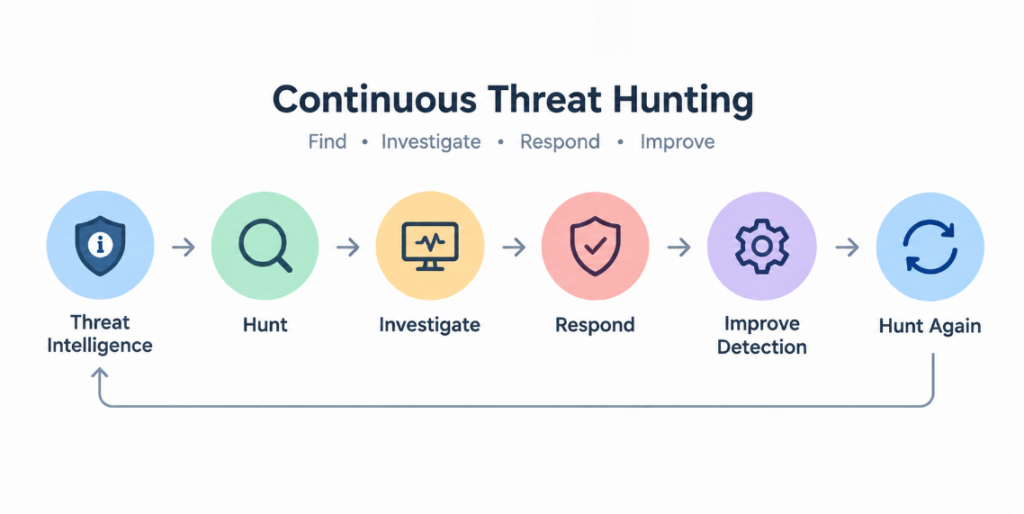
This creates a continuous improvement loop:
Hunt → Discover → Investigate → Respond → Improve Detection → Hunt Again
Why EDR/XDR and NDR Strengthen Threat Hunting
Threat hunting requires visibility.
Without sufficient telemetry, security analysts cannot effectively investigate hidden threats.
EDR/XDR provides visibility into endpoint and broader security activity, helping analysts investigate suspicious processes, behaviors, identities, and related events.
NDR provides deeper visibility into network behavior and can help identify suspicious communication patterns that may not be obvious from endpoint telemetry alone.
CORVIT’s managed security portfolio combines EDR/XDR, AI-Driven NDR, Threat Intelligence, and SOC capabilities to support detection and investigation across different security layers.
The combination is important because an attacker may evade one control while leaving evidence somewhere else.
The Role of the Security Operations Center (SOC)
A Security Operations Center (SOC) provides the operational foundation for continuous monitoring, investigation, and response.
However, an effective SOC should not operate as an alert-processing factory.
The objective should be to understand what is happening across the environment and continuously improve the organization’s ability to detect and respond to threats.
A mature SOC combines:
- Security monitoring
- Threat detection
- Threat Intelligence
- Behavioral analytics
- Threat Hunting
- Incident investigation
- Incident Response
- Security automation
- Detection engineering
CORVIT’s Cyber Defense Center provides 24/7 monitoring, threat detection, investigation, and incident response using security technologies, threat intelligence, advanced analytics, and expert analysts.
Threat hunting adds the proactive dimension to these capabilities.
Threat Hunting and MITRE ATT&CK
The MITRE ATT&CK Framework provides a useful foundation for threat-informed hunting because it organizes adversary behavior into tactics and techniques.
Instead of asking only:
“Do we have malware?”
security teams can ask:
“Can we identify evidence of the techniques an attacker may use after gaining access?”
This shifts security operations from simple signature-based detection toward behavior-focused defense.
MITRE’s TTP-based hunting research explains how adversary tactics, techniques, and procedures can be used to guide proactive hunting and detection development.
Why Threat Hunting Is Particularly Important for GCC Organizations
Organizations across the GCC are rapidly expanding digital services and interconnected infrastructure.
Financial institutions, telecommunications providers, government entities, healthcare organizations, energy companies, retailers, manufacturers, and technology providers increasingly rely on cloud services, connected systems, digital identities, APIs, remote access, and distributed infrastructure.
This creates a broad environment for attackers to target.
For organizations operating critical or highly regulated environments, the consequences of undetected compromise can include:
- Data exposure
- Financial losses
- Operational disruption
- Intellectual property theft
- Service interruption
- Regulatory consequences
- Reputational damage
Threat hunting can help organizations move from a purely reactive security posture toward a more proactive cybersecurity strategy.
CISA has specifically emphasized proactive threat hunting for critical infrastructure defenders and organizations facing persistent adversaries.
Why Continuous Threat Hunting Matters
Threat hunting should not be treated as a once-a-year security exercise.
The threat landscape changes continuously.
New vulnerabilities emerge. Attack techniques evolve. Credentials are compromised. Cloud configurations change. New applications are deployed. Employees change roles. Attackers adapt.
A hunting strategy that was effective six months ago may not address today’s risks.
Continuous hunting helps organizations repeatedly ask:
- What has changed?
- What new attack techniques should we look for?
- What security gaps have appeared?
- What suspicious behavior might our existing detections miss?
This is particularly important because threat hunting can also identify weaknesses in existing security controls.
A failed hunt is not necessarily wasted effort.
If a security team discovers that it cannot investigate a particular attack technique because the required telemetry is unavailable, that finding identifies a visibility gap.
Threat Hunting Should Improve Detection
One of the most important principles of modern threat hunting is that hunting should continuously improve the broader security program.
Suppose a threat hunter discovers suspicious PowerShell activity that was not generating an alert.
The organization can investigate the behavior, determine whether it is malicious, and then develop a detection rule or analytic for similar activity in the future.
The result is a continuous feedback loop:
Threat Hunting → New Discovery → Detection Engineering → Automated Detection → Threat Hunting
This helps security teams progressively strengthen their defensive capabilities.
CISA guidance also demonstrates how threat hunting can use indicators, behaviors, and adversary techniques to identify possible compromise and improve defensive visibility.
How CORVIT MSSP Supports Continuous Threat Hunting
As a Managed Security Service Provider (MSSP), CORVIT MSSP combines continuous monitoring, threat intelligence, security analytics, and expert-led investigation to help organizations identify threats that may bypass conventional security controls.
CORVIT’s Threat Hunting service proactively searches across networks, endpoints, and cloud environments for suspicious behaviors and indicators of compromise. The service combines advanced analytics, threat intelligence, and expert investigation to identify hidden threats and reduce potential dwell time.
Its broader managed security ecosystem includes:
- Threat Hunting
- 24/7 Security Operations Center
- Threat Intelligence
- EDR/XDR
- AI-Driven NDR
- Identity Threat Detection & Response
- Cloud Security
- Managed Firewall/IPS
- Digital Forensics & Incident Response
- Vulnerability Management
These capabilities support a security lifecycle that extends from Detect and Hunt through Respond, Recover, and Evolve. CORVIT’s broader MSSP model is designed around continuous protection, visibility, response, recovery, and security improvement.
The objective is not simply to generate more alerts.
It is to help organizations understand which threats matter, uncover hidden activity, investigate suspicious behavior, and strengthen security controls over time.
Conclusion
Threat detection remains a fundamental component of cybersecurity, but detection alone cannot guarantee that every sophisticated threat will be identified. Attackers increasingly use legitimate credentials, trusted tools, evolving techniques, and low-and-slow behaviors to reduce their chances of triggering conventional security controls. Continuous Threat Hunting provides the proactive layer needed to search for hidden threats, validate security assumptions, identify gaps in visibility, and uncover adversary behavior that automated detection may miss. By combining Threat Intelligence, EDR/XDR, NDR, behavioral analytics, MITRE ATT&CK-informed hunting, SOC expertise, and Incident Response, organizations can move from simply waiting for alerts toward actively searching for threats. For GCC organizations, this proactive approach is increasingly important for strengthening cyber resilience and reducing the opportunity for attackers to remain undetected.
Stop Waiting for the Alert. Start Hunting the Threat.
As attackers become more adaptive, organizations need more than automated alerts and traditional security controls. CORVIT MSSP helps organizations strengthen proactive cyber defense through Threat Hunting, Threat Intelligence, EDR/XDR, AI-Driven NDR, and 24/7 Cyber Defense Center capabilities.
Explore CORVIT MSSP Threat Hunting: https://corvit.com/networks/mssp/threat-hunting/
FAQs
1- What is Threat Hunting?
Threat Hunting is a proactive cybersecurity practice in which security professionals actively search networks, endpoints, cloud environments, identities, and other systems for evidence of malicious activity that may have bypassed automated security controls.
2- Why isn’t automated threat detection enough?
Automated detection depends on available telemetry, detection rules, behavioral models, signatures, and other analytics. Sophisticated attackers may use legitimate credentials, trusted tools, or previously unknown behaviors that do not immediately trigger an alert. Threat hunting provides an additional proactive layer of investigation.
3- How does Threat Intelligence support Threat Hunting?
Threat Intelligence provides context about threat actors, attack techniques, malicious infrastructure, IOCs, vulnerabilities, and emerging campaigns. Hunters can use this information to develop focused hunting hypotheses and investigate relevant activity.
4- How does CORVIT MSSP provide Threat Hunting?
CORVIT’s Threat Hunting service proactively searches across networks, endpoints, and cloud environments using behavioral analytics, threat intelligence, and expert investigation. It also integrates with the broader CORVIT MSSP ecosystem, including the 24/7 Cyber Defense Center, EDR/XDR, NDR, and Threat Intelligence.