
SIEM vs. XDR vs. NDR: What Does Your SOC Really Need?
September 9, 2026
Why Threat Detection Alone Isn’t Enough: The Need for Continuous Threat Hunting
September 23, 2026Discover how GCC organizations can move beyond prevention to continuous cyber resilience through monitoring, threat detection, response, recovery, and proactive defense with CORVIT MSSP.
Introduction
For years, cybersecurity strategy largely focused on one objective: “Prevent the attack.”
Organizations invested in firewalls, endpoint protection, access controls, vulnerability management, secure networks, and other preventive technologies, assuming stronger defenses would keep attackers out of the environment.
Prevention remains essential. But it is no longer enough.
Modern organizations operate across cloud platforms, remote users, applications, interconnected networks, third-party services, identities, data centers, and increasingly complex OT environments. This creates an attack surface that cannot realistically be protected by prevention alone.
At the same time, cyber threats are becoming faster, more automated, and more disruptive. The World Economic Forum’s Global Cybersecurity Outlook 2026 highlights AI, geopolitical volatility, supply-chain complexity, and growing interdependencies as factors increasing cyber risk and emphasizes cyber resilience as an increasingly important strategic priority.
For GCC organizations, this shift is particularly important. Digital transformation is accelerating across Qatar, Saudi Arabia, the UAE, Bahrain, Kuwait, and Oman, while critical infrastructure, financial services, telecommunications, government services, healthcare, and large enterprises increasingly depend on digital systems.
The question is therefore no longer:
“How do we prevent every cyberattack?”
It is:
“How quickly can we detect, contain, recover from, and learn from an attack when prevention fails?”
That is the foundation of Cyber Resilience.
What Is Cyber Resilience?
Cyber resilience is an organization’s ability to prepare for, withstand, respond to, recover from, and adapt to cyber threats while maintaining critical business operations.
Cybersecurity primarily focuses on reducing the probability and impact of compromise.
Cyber resilience goes further.
It recognizes that even organizations with strong security controls can experience:
- Credential compromise
- Ransomware
- Insider threats
- Supply-chain attacks
- Cloud incidents
- Zero-day exploitation
- Data breaches
- DDoS attacks
- Identity attacks
- Operational disruption
A resilient organization does not assume that every attack can be stopped.
Instead, it builds the capabilities required to continue operating and recover quickly when something goes wrong.
This means cyber resilience must connect prevention with detection, response, recovery, and continuous improvement.
Why Prevention Alone Is No Longer Enough
Traditional security architectures often concentrate heavily on the perimeter.
Firewalls protect the network.
Endpoint security protects devices.
Email security protects communications.
Access controls protect identities.
These controls remain important, but modern enterprise environments are no longer defined by a single perimeter.
Users connect remotely.
Applications run in the cloud.
APIs connect business systems.
Third parties access corporate environments.
Employees use multiple devices.
OT environments interact with IT infrastructure.
Cloud workloads communicate across distributed environments.
As a result, attackers can potentially enter through many different paths.
A compromised identity, vulnerable application, exposed cloud workload, malicious email, or third-party connection can potentially bypass controls designed around the traditional perimeter.
This is why continuous defense is becoming a more important security principle.
The GCC Cybersecurity Landscape Is Becoming More Complex
The GCC is undergoing rapid digital transformation across both public and private sectors.
Organizations are expanding:
- Cloud adoption
- Digital government services
- Financial technology
- Smart infrastructure
- Telecommunications
- Industrial automation
- Connected systems
- AI adoption
- Remote and hybrid operations
This digital expansion creates economic opportunities but also increases cybersecurity dependencies.
The WEF’s 2026 outlook notes that cyber risk is increasingly interconnected with geopolitical, technological, and economic factors, with disruptions potentially cascading across highly connected digital ecosystems.
Regulatory environments are also increasingly emphasizing resilience.
For example, Saudi Arabia’s National Cybersecurity Authority’s Critical Systems Cybersecurity Controls explicitly include Cybersecurity Resilience alongside governance, defense, and third-party/cloud security.
The NCA’s Essential Cybersecurity Controls also include areas such as backup and recovery, vulnerability management, security monitoring, incident and threat management, and business continuity-related resilience.
This demonstrates an important shift:
Cybersecurity is increasingly being viewed as an operational resilience requirement, not simply an IT security function.
Detection Is the Bridge Between Prevention and Resilience
Prevention reduces the likelihood of compromise.
Detection reduces the time an attacker can remain undetected.
This distinction matters.
An attacker who is blocked immediately may have little impact.
An attacker who remains inside an environment for days or weeks can potentially:
- Discover internal systems
- Steal credentials
- Escalate privileges
- Move laterally
- Access sensitive data
- Establish persistence
- Disrupt operations
This is why organizations need continuous Threat Detection rather than relying exclusively on preventive controls.
A modern Cyber Defense Center (SOC) can continuously monitor networks, endpoints, cloud platforms, and applications while using threat intelligence, behavioral analytics, and expert investigation to identify suspicious activity. CORVIT’s Cyber Defense Center is designed around this 24/7 monitoring, detection, and response model.
Why 24/7 Security Monitoring Matters
Cyberattacks do not operate according to business hours.
An attack can begin at:
- 2:00 AM
- During a public holiday
- Over a weekend
- During a system migration
- During a major business event
If monitoring stops when internal security teams leave the office, attackers gain an operational advantage.
A 24/7 SOC provides continuous monitoring and enables security teams to identify and investigate suspicious activity regardless of when it occurs.
CORVIT’s Cyber Defense Center provides 24/7 security monitoring, threat detection, centralized visibility, and incident response supported by expert analysts and advanced security technologies.
This is one of the key differences between traditional security and continuous cyber defense.
Threat Intelligence Makes Resilience More Proactive
Cyber resilience should not be based solely on what an organization has already experienced.
Security teams also need to understand what attackers are doing across the wider threat landscape.
Threat intelligence provides context around:
- Threat actors
- Malware
- Attack campaigns
- Indicators of compromise
- Malicious infrastructure
- Vulnerabilities
- Attacker techniques
- Emerging threats
This intelligence can then be applied to internal security monitoring and threat detection.
CORVIT’s Threat Intelligence service uses AI-powered threat correlation to connect global threat intelligence with organizational security events, helping security teams identify emerging threats and turn intelligence into actionable security decisions.
This creates a proactive security loop:
Global Threat Intelligence → Internal Visibility → Detection → Investigation → Response
Instead of waiting for an attack to become obvious, organizations can use external intelligence to improve their ability to identify potential threats earlier.
Threat Hunting: Looking for What Detection Misses
Even advanced detection technologies cannot guarantee that every threat will generate an alert.
Attackers may use legitimate credentials, legitimate administrative tools, stealthy techniques, or previously unknown methods.
This makes Threat Hunting an important component of cyber resilience.
Threat hunting proactively searches for suspicious behavior that may not have triggered conventional detection mechanisms.
A mature threat-hunting capability can investigate:
- Unusual authentication patterns
- Suspicious endpoint behavior
- Lateral movement
- Command-and-control activity
- Abnormal network traffic
- Privilege escalation
- Persistence mechanisms
- Unusual cloud activity
CORVIT’s Threat Hunting capability searches across networks, endpoints, and cloud environments using threat intelligence, advanced analytics, and expert investigation.
This changes the security question from:
“What alerted us?”
to:
“What could already be inside our environment that we have not detected?”
That mindset is fundamental to continuous defense.
Identity Has Become a Critical Resilience Layer
Modern cyber resilience cannot focus only on networks and endpoints.
Identity has become one of the most important security layers because attackers increasingly target:
- User credentials
- Privileged accounts
- Authentication systems
- Remote access
- Service accounts
- Cloud identities
A compromised identity can potentially provide an attacker with legitimate access that bypasses traditional perimeter controls.
This is why identity security should be integrated into the broader cyber resilience strategy.
CORVIT’s portfolio includes Identity Threat Detection & Response (ITDR) to help identify identity-based attacks targeting authentication systems and user credentials.
Combined with Zero Trust principles, identity security helps organizations continuously validate users, devices, and access requests rather than assuming that access should automatically be trusted.
CORVIT’s Zero Trust architecture uses SASE/SSE capabilities to continuously verify users, devices, and connections while protecting applications and data in modern hybrid environments.
Protecting the Network Is Still Important
Moving toward resilience does not mean abandoning preventive security.
Network protection remains a foundational layer.
Modern organizations still require:
- Managed Firewall/IPS
- Secure Web Gateway
- DDoS protection
- Network segmentation
- Secure SD-WAN
- Network monitoring
CORVIT’s Managed Firewall/IPS service combines continuous monitoring, threat prevention, and expert management to help protect enterprise networks from malicious traffic and unauthorized access.
The difference is that network protection should now operate as part of a broader security ecosystem.
Protection prevents.
Detection identifies.
Response contains.
Recovery restores.
Cloud and OT Must Be Part of the Resilience Strategy
Cyber resilience cannot be achieved if critical environments are excluded from security monitoring.
For modern enterprises, this includes cloud infrastructure and, increasingly, OT and industrial systems.
Cloud environments introduce risks such as:
- Misconfiguration
- Excessive permissions
- Exposed workloads
- Insecure APIs
- Data exposure
- Identity compromise
OT environments introduce a different challenge because cyber incidents can potentially affect physical processes and operational continuity.
CORVIT supports security across cloud, IT, OT, and telecom environments, while its portfolio includes Cloud Security, AI-Driven NDR, ICS/SCADA/IoT monitoring, and other capabilities designed for interconnected environments.
This is particularly relevant for GCC organizations operating critical infrastructure, industrial environments, energy-related systems, telecommunications, and smart infrastructure.
Recovery Is a Security Capability
One of the biggest misconceptions about cybersecurity is that recovery begins after security ends.
In reality, recovery should be designed into cybersecurity from the beginning.
A resilient organization should know:
- Which systems are mission-critical
- Which data must be restored first
- How backups are protected
- How recovery procedures are tested
- Who makes recovery decisions
- How long critical services can remain unavailable
CORVIT’s Backup & Recovery services include secure backup infrastructure and expert support, alongside Disaster Recovery & Business Continuity capabilities designed to help organizations maintain operations during outages or cyber incidents.
The goal is not simply to restore technology.
It is to restore business operations safely and efficiently.
Cyber Resilience Requires Continuous Improvement
Cyber resilience is not a project that ends when a security architecture is deployed.
Threats change.
Technology changes.
Business operations change.
Regulations change.
Attack techniques change.
Therefore, resilience must continuously evolve.
Every security incident should provide information that can improve:
- Detection rules
- Security policies
- Access controls
- Incident response playbooks
- Threat-hunting hypotheses
- Backup strategies
- Security awareness
- Network segmentation
- Cloud controls
- Identity protection
This creates a continuous improvement cycle:
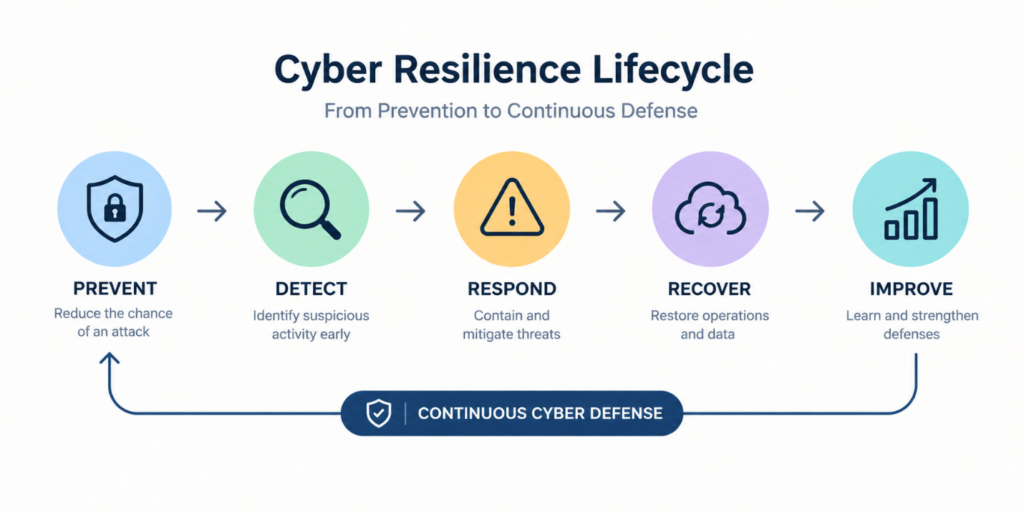
That final step, defend again, is what separates continuous cyber resilience from traditional incident response.
Cyber Resilience and Regulatory Expectations in the GCC
Cyber resilience is also increasingly connected with regulatory and governance requirements.
Saudi Arabia provides a strong example. Its cybersecurity control framework includes dedicated areas covering cybersecurity resilience, critical systems, cloud computing, OT, data, and third-party security.
For organizations operating across multiple GCC countries, this creates an additional challenge: security programs need to account for both organizational risk and applicable national requirements.
A mature Governance, Risk and Compliance (GRC) approach therefore needs to connect cybersecurity controls with:
- Business continuity
- Incident response
- Risk management
- Third-party security
- Cloud security
- Data protection
- Security monitoring
- Recovery planning
- Regulatory requirements
Cyber resilience should ultimately become part of enterprise risk management, not remain isolated within the IT department.
How CORVIT MSSP Helps Build Continuous Cyber Resilience
CORVIT MSSP approaches cyber resilience as a complete lifecycle rather than a collection of individual security products.
Its integrated model spans:
- Access: Identify vulnerabilities, exposures, and security gaps before attackers exploit them.
- Govern: Strengthen cybersecurity governance, compliance, policies, and organizational resilience.
- Protect: Deploy layered security across networks, endpoints, applications, cloud environments, and data.
- Detect: Use 24/7 monitoring, AI-assisted analytics, EDR/XDR, NDR, and threat intelligence to identify suspicious activity.
- Respond: Investigate, contain, and mitigate security incidents through expert-led response.
- Recover: Support backup, disaster recovery, business continuity, and operational restoration.
- Evolve: Use threat hunting, intelligence, analytics, and lessons learned to continuously improve security posture.
This lifecycle reflects the central principle of cyber resilience: “Security should not stop when an attack gets through.”
It should become stronger because of what the organization learns from it.
Why Cyber Resilience Is Becoming a GCC Business Priority
For GCC organizations, cyber resilience is increasingly a business requirement because digital services are deeply connected to operational continuity.
A prolonged cyber incident can affect:
- Customer services
- Revenue
- Critical infrastructure
- Supply chains
- Data availability
- Regulatory compliance
- Brand reputation
- Public trust
The objective should therefore be broader than simply achieving “zero incidents.”
A more meaningful resilience strategy asks:
- Can the organization continue operating during an attack?
- Can it detect compromise quickly?
- Can it contain the attacker before the impact expands?
- Can it recover critical services safely?
- Can it adapt its defenses afterward?
Organizations that can answer these questions confidently are better positioned to operate in an increasingly unpredictable cyber environment.
Conclusion
Cyber resilience represents a fundamental shift in how organizations approach cybersecurity. Prevention remains an essential first line of defense, but modern organizations cannot assume that every attack will be stopped at the perimeter. As GCC enterprises expand their use of cloud, connected infrastructure, digital services, AI, remote access, and interconnected IT and OT environments, resilience requires continuous visibility, threat intelligence, proactive hunting, rapid incident response, reliable recovery, and ongoing security improvement. CORVIT MSSP helps organizations move toward this model through an integrated lifecycle spanning Access, Govern, Protect, Detect, Respond, Recover, and Evolve. The objective is not simply to prevent every attack; it is to ensure that when threats emerge, the organization can detect them, contain them, recover quickly, maintain business continuity, and become stronger after every incident.
Cyber resilience should not begin after a breach.
Build the capability to prepare, detect, respond, recover, and evolve before the next disruption occurs.
CORVIT MSSP combines 24/7 Cyber Defense, threat intelligence, EDR/XDR, AI-Driven NDR, threat hunting, identity security, incident response, cloud security, and recovery capabilities to help organizations build a stronger and more resilient security posture.
Explore CORVIT MSSP: https://corvit.com/networks/mssp/
FAQs
1- What is cyber resilience?
Cyber resilience is an organization’s ability to prepare for, withstand, detect, respond to, recover from, and adapt to cyber incidents while maintaining critical business operations.
2- How is cyber resilience different from cybersecurity?
Cybersecurity traditionally focuses on protecting systems and preventing attacks. Cyber resilience includes prevention but also emphasizes detection, response, recovery, continuity, and continuous improvement.
3- How does threat intelligence support cyber resilience?
Threat intelligence provides information about emerging threats, threat actors, malicious infrastructure, vulnerabilities, and attacker techniques. This intelligence can improve detection, threat hunting, prioritization, and response.
4- Why is threat hunting important?
Threat hunting proactively searches for suspicious activity that may not have generated a conventional security alert. It helps organizations identify threats that automated detection may miss.
5- How can an MSSP improve cyber resilience?
An MSSP can provide 24/7 monitoring, security technologies, threat intelligence, expert analysts, incident response, threat hunting, recovery support, and continuous security management without requiring an organization to build every capability internally.