

The New Cybersecurity Battlefield: Why Attackers Are Targeting Business Applications
September 2, 2026
Cyber Resilience in the GCC: Moving Beyond Prevention to Continuous Defense
September 15, 2026Discover the differences between SIEM, XDR, and NDR and learn how organizations can build a stronger SOC with the right detection and response strategy.
Introduction
Modern organizations generate enormous volumes of security data every day. Firewalls, endpoints, cloud platforms, identity systems, applications, servers, email systems, and network infrastructure continuously produce events that security teams must monitor and investigate.
For a modern Security Operations Center (SOC), the challenge is no longer simply collecting security alerts. The real challenge is determining which events matter, understanding how seemingly unrelated activities are connected, and responding quickly before an attacker can move further into the environment.
This is where technologies such as Security Information and Event Management (SIEM), Extended Detection and Response (XDR), and Network Detection and Response (NDR) have become increasingly important.
However, these technologies are not interchangeable.
A SIEM primarily provides centralized security data collection, log management, correlation, analytics, and investigation capabilities. XDR extends detection and response across multiple security domains, helping security teams correlate activity across endpoints, networks, cloud, email, identity, and other environments. NDR focuses specifically on network behavior and communication, helping identify suspicious activity that may not be visible from endpoint or log data alone. NIST describes SIEM as providing centralized logging capabilities across different log types, while its glossary also recognizes XDR as an established detection and response approach.
The important question for organizations is therefore not simply “Which technology is better?”
And
“What does our SOC actually need, and how should these technologies work together?”
For organizations across Qatar, Saudi Arabia, the UAE, Bahrain, Kuwait, and Oman, this distinction is particularly important as hybrid infrastructure, cloud adoption, remote work, operational technology, and digital transformation continue to expand the cybersecurity attack surface.
Understanding SIEM, XDR, and NDR
SIEM, XDR, and NDR address different parts of the security detection and response lifecycle.
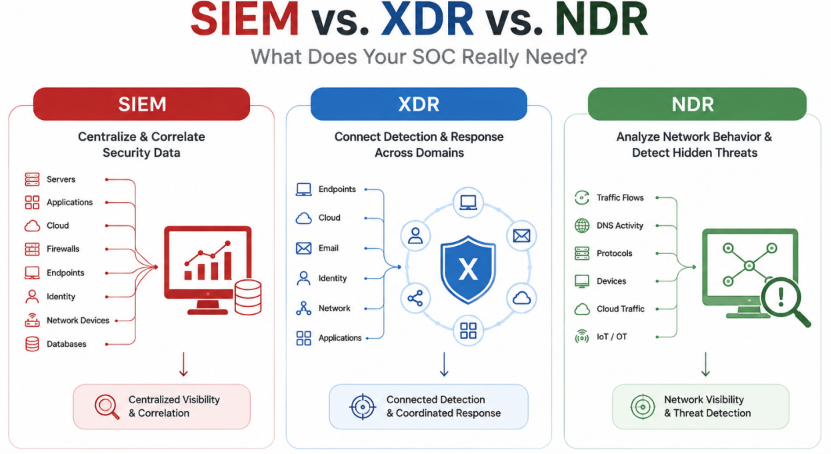
A simplified view is:
- SIEM → Centralize and correlate security data
- XDR → Connect detection and response across security domains
- NDR → Analyze network behavior and detect threats within network traffic
The technologies can operate independently, but their greatest value often comes when they are integrated into a broader security architecture.
A mature SOC may use:
- SIEM for centralized visibility and security analytics
- XDR for cross-domain detection and coordinated response
- NDR for network-level visibility and behavioral detection
- EDR for endpoint telemetry and response
- Threat Intelligence for contextual enrichment
- SOAR for workflow automation
- Human analysts for investigation, decision-making, and incident response
The objective is not to accumulate security tools. The objective is to create connected visibility and actionable intelligence across the organization’s environment.
What Is SIEM?
Security Information and Event Management (SIEM) is a technology designed to collect and analyze security-related information from multiple systems.
A SIEM can ingest logs and events from:
- Firewalls
- Servers
- Endpoints
- Applications
- Cloud platforms
- Identity systems
- Authentication services
- Network devices
- Security appliances
- Databases
- Vulnerability management platforms
NIST describes SIEM as providing centralized logging capabilities for different log types and notes that SIEM tools can gather security data from information-system components and present it as actionable information through a single interface.
The primary strength of SIEM is centralized visibility.
Instead of analysts examining individual systems independently, security events can be normalized, correlated, searched, retained, and investigated from a central platform.
Key SIEM Capabilities
A modern SIEM commonly provides:
- Centralized log collection
- Event normalization
- Security event correlation
- Rule-based detection
- Behavioral analytics
- Security dashboards
- Investigation and search
- Compliance reporting
- Long-term log retention
- Threat intelligence integration
- Incident tracking
SIEM is particularly valuable when organizations need a comprehensive historical record of security activity.
For example, an analyst investigating a compromised account may need to correlate authentication logs, VPN activity, endpoint events, firewall logs, cloud activity, and application access.
SIEM provides the foundation for this type of investigation.
What Is XDR?
Extended Detection and Response (XDR) is designed to extend detection and response beyond a single security layer.
Instead of treating endpoints, networks, email, identity, and cloud environments as separate security domains, XDR seeks to integrate telemetry and security controls across these domains.
Modern XDR platforms may incorporate data from:
- Endpoints
- Networks
- Cloud workloads
- Servers
- Identity systems
- Applications
- Security gateways
The objective is to provide security teams with greater context and improve their ability to detect, investigate, and respond to threats across multiple security layers.
NIST’s cybersecurity glossary recognizes Extended Detection and Response as XDR, while industry implementations commonly position XDR as a way to connect telemetry and response capabilities across multiple security domains.
Key XDR Capabilities
XDR can help organizations:
- Correlate security signals across multiple technologies
- Identify multi-stage attacks
- Reduce isolated alerts
- Improve incident investigation
- Automate selected response actions
- Provide broader attack visibility
- Accelerate threat detection
- Support coordinated incident response
For example, consider a scenario where an employee receives a malicious email, executes a payload on a laptop, communicates with an external command-and-control server, and then attempts to access sensitive cloud resources.
A traditional security tool might detect only one part of this sequence.
XDR aims to connect these signals into a broader incident narrative.
What Is NDR?
Network Detection and Response (NDR) focuses on identifying threats through network activity and communication patterns.
NDR analyzes network telemetry to identify suspicious behavior that may not be obvious from endpoint logs or traditional security controls.
It can examine:
- Network traffic patterns
- East-west traffic
- North-south traffic
- DNS activity
- Command-and-control communication
- Unusual connections
- Data transfer behavior
- Lateral movement
- Network reconnaissance
- Suspicious protocols
- Abnormal device behavior
This makes NDR particularly valuable in environments where organizations need visibility into communication between systems and devices.
Network monitoring can also help identify threats involving unmanaged or difficult-to-monitor assets. Industry guidance describes NDR as monitoring communications within networks to detect, investigate, and respond to threats that may otherwise remain hidden across on-premises, cloud, and hybrid environments.
Key NDR Capabilities
NDR can provide:
- Network behavioral analytics
- Anomaly detection
- Lateral movement detection
- Command-and-control detection
- Network reconnaissance detection
- Threat hunting
- Encrypted traffic analysis
- Network visibility
- Investigation support
- Incident response integration
NDR therefore fills an important visibility gap between endpoint-focused security and centralized log analysis.
SIEM vs. XDR vs. NDR: The Key Difference
The simplest way to understand the difference is to consider what each technology is primarily designed to accomplish.
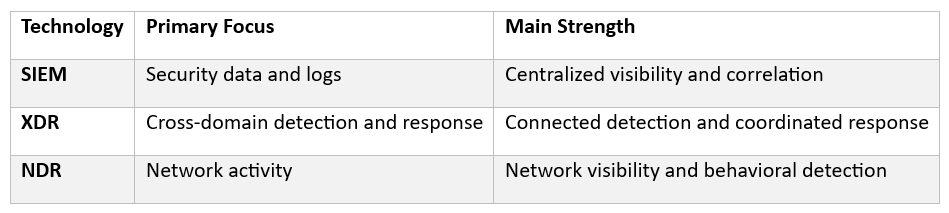
These technologies should not necessarily be viewed as direct competitors.
Instead, they can complement one another.
SIEM asks:
“What happened across my environment?”
NDR asks:
“What is happening across my network?”
XDR asks:
“How are these security signals connected, and how should we respond?”
This distinction becomes critical when designing a modern SOC.
Why SIEM Alone May Not Be Enough
SIEM remains an important component of enterprise cybersecurity, but simply collecting logs does not automatically create effective threat detection.
Organizations can face several challenges:
- Massive log volumes
- Complex correlation rules
- False positives
- Data ingestion costs
- Alert fatigue
- Limited real-time network visibility
- Lack of endpoint context
- Manual investigations
- Skills shortages
Traditional SIEM architectures may also depend heavily on analysts creating and maintaining detection rules.
NIST documentation notes that SIEM platforms correlate information from multiple security-related logs, but also highlights practical limitations such as delays in receiving log data and the fact that SIEM may not receive every detail available from the original security source.
This does not make SIEM obsolete.
Instead, it means organizations should understand where SIEM fits within the broader security architecture.
Why XDR Alone May Not Be Enough
XDR can provide powerful cross-domain detection and response, but organizations should also consider visibility requirements beyond the telemetry natively available to their XDR platform.
Challenges can include:
- Limited visibility into certain legacy systems
- Data-source compatibility
- Vendor ecosystem dependencies
- Operational technology visibility
- Long-term log retention requirements
- Compliance-driven reporting
- Specialized network monitoring requirements
XDR is strongest when it has access to meaningful telemetry from the organization’s critical security layers.
Without sufficient data, even an advanced detection platform can have visibility gaps.
Why NDR Is Critical for Network Visibility
Modern organizations increasingly rely on cloud, hybrid infrastructure, IoT, operational technology, and interconnected systems.
Not every device can run an endpoint security agent.
Some systems may be:
- Legacy systems
- IoT devices
- Industrial systems
- Network appliances
- Specialized applications
- Operational technology assets
- Third-party devices
NDR can provide visibility into network behavior without depending entirely on endpoint agents.
This is especially valuable for organizations operating complex environments where network traffic can reveal suspicious activity that endpoint telemetry does not capture.
NDR and EDR can also complement one another by bringing together network and endpoint telemetry for investigation and response.
What Does a Modern SOC Really Need?
The answer is rarely SIEM, XDR or NDR.
A mature SOC may need all three, depending on its size, infrastructure, risk profile, compliance requirements, and operational capabilities.
A practical security architecture could look like:
Security Sources → SIEM → Analytics & Correlation
Endpoints + Cloud + Email + Identity → XDR → Detection & Response
Network Traffic → NDR → Network Analytics & Threat Detection
SIEM + XDR + NDR → SOC Analysts → Incident Response
This integrated approach allows security teams to see the environment from multiple perspectives.
SIEM provides centralized historical and contextual visibility.
NDR provides deep network visibility.
XDR connects detection and response across multiple security layers.
How SIEM, XDR, and NDR Work Together
Consider a hypothetical ransomware attack.
An employee receives a malicious email.
Step 1 – Email Security
The malicious attachment reaches the user’s mailbox.
Step 2 – Endpoint Detection
The file executes and creates suspicious processes.
Step 3 – Network Detection
The compromised endpoint begins communicating with unusual external infrastructure.
Step 4 – Identity Monitoring
The compromised account attempts to authenticate to additional systems.
Step 5 – SIEM Correlation
Security logs from identity systems, firewalls, endpoints, applications, and cloud platforms are correlated.
Step 6 – XDR Investigation
XDR connects endpoint, network, identity, and other available telemetry to establish the broader attack chain.
Step 7 – Incident Response
Security analysts investigate the incident and initiate containment and remediation actions.
The Role of Threat Intelligence
Threat Intelligence adds another layer of context to SIEM, XDR, and NDR.
Threat intelligence can provide information about:
- Malicious IP addresses
- Domains
- File hashes
- Attack techniques
- Threat actors
- Malware campaigns
- Command-and-control infrastructure
- Emerging vulnerabilities
When threat intelligence is correlated with internal telemetry, security teams can better determine whether suspicious activity represents a genuine threat.
For example, NDR may identify communication with a suspicious external domain. Threat intelligence can provide additional context about that domain, while SIEM can identify whether other systems have communicated with the same infrastructure.
XDR can then help connect the activity with endpoint or identity events.
The result is a more complete investigation.
From Detection to Incident Response
Detection is only one part of cybersecurity.
Organizations must also be capable of responding effectively.
Modern Incident Response requires organizations to identify, analyze, contain, eradicate, and recover from security incidents.
NIST’s current incident-response guidance emphasizes integrating incident response into broader cybersecurity risk management and improving the efficiency and effectiveness of detection, response, and recovery activities.
SIEM, XDR, and NDR can support this process by providing the evidence and context required by security teams.
The most effective architecture therefore connects:
Detect → Investigate → Prioritize → Contain → Remediate → Recover → Improve
How CORVIT MSSP Helps Build a Modern SOC
As a Managed Security Service Provider (MSSP), CORVIT MSSP helps organizations build and operate integrated cybersecurity capabilities without requiring them to manage every security function internally.
CORVIT MSSP’s approach can combine:
- SIEM and security analytics
- AI-driven NDR
- EDR/XDR
- Threat Intelligence
- Managed Firewall and IPS
- Cloud Security
- Identity security
- Zero Trust
- Vulnerability Management
- Digital Forensics & Incident Response
- 24/7 SOC monitoring
- Security orchestration and response
This enables organizations to move beyond isolated security products toward a more coordinated cyber defense strategy.
The Cyber Defense Center (SOC) provides continuous monitoring and expert-led security operations designed to help organizations identify threats, investigate suspicious activity, and respond to incidents.
For organizations that lack sufficient internal SOC resources, an MSSP model can also provide access to specialized cybersecurity expertise, operational processes, monitoring capabilities, and security technologies.
Which Technology Should Your Organization Prioritize?
There is no universal answer.
Organizations should evaluate their security architecture based on business requirements and risk.
Choose SIEM when you need:
- Centralized log management
- Security event correlation
- Compliance reporting
- Historical investigation
- Broad data visibility
- Centralized security analytics
Prioritize XDR when you need:
- Cross-domain detection
- Integrated security telemetry
- Faster investigations
- Coordinated response
- Reduced security-tool silos
- Better incident context
Prioritize NDR when you need:
- Deep network visibility
- Network behavioral analytics
- Lateral movement detection
- Visibility into unmanaged assets
- Threat hunting across network activity
- Detection of suspicious communications
Consider an integrated approach when you need:
- Enterprise-wide visibility
- 24/7 monitoring
- Complex hybrid environments
- Advanced threat detection
- Faster incident response
- Multiple security data sources
- A mature SOC operating model
Conclusion
AI is transforming both sides of the cybersecurity landscape, giving attackers greater speed and scale while enabling defenders to detect, investigate, and respond to threats more intelligently. Organizations can no longer rely solely on traditional security controls; they need a balanced approach that combines AI-powered cybersecurity, continuous monitoring, threat intelligence, proactive threat hunting, automation, and experienced security professionals. With CORVIT MSSP, organizations across the GCC can strengthen their Cyber Defense through integrated managed security services, AI-driven detection, EDR/XDR, NDR, ITDR, Cloud Security, and 24/7 Cyber Defense Center capabilities.
Prepare your organization for the AI-driven threat landscape—connect with CORVIT MSSP today to strengthen your cybersecurity strategy and build lasting Cyber Resilience.
Explore CORVIT MSSP Cyber Defense Center (SOC):
https://corvit.com/networks/mssp/cyber-defense-center-soc/
FAQs
1- What is the difference between SIEM, XDR, and NDR?
SIEM focuses primarily on collecting, correlating, and analyzing security logs and events. XDR extends detection and response across multiple security domains such as endpoints, networks, cloud, email, and identity. NDR focuses specifically on network behavior and communication to identify suspicious or malicious activity.
2- Is SIEM becoming obsolete because of XDR?
No. SIEM continues to provide important centralized logging, investigation, correlation, compliance, and historical visibility. XDR and SIEM can complement one another rather than replace one another.
3- Does every organization need NDR?
Not necessarily. NDR becomes particularly valuable for organizations with complex networks, hybrid environments, unmanaged devices, IoT, operational technology, or a strong requirement for network-level threat visibility.
4- Can SIEM, XDR, and NDR work together?
Yes. Integrating these technologies can provide broader visibility and stronger detection capabilities. SIEM can centralize security data, NDR can provide network-level analytics, and XDR can correlate signals across multiple security domains and support response.
5- What does CORVIT MSSP provide for SOC operations?
CORVIT MSSP provides managed cybersecurity capabilities including 24/7 SOC monitoring, advanced threat detection, AI-driven NDR, EDR/XDR, Threat Intelligence, managed security services, incident response, cloud security, and other security capabilities designed to strengthen enterprise cyber defense.