

How AI Is Changing Both Cyberattacks and Cyber Defense
August 25, 2026
SIEM vs. XDR vs. NDR: What Does Your SOC Really Need?
September 9, 2026The New Cybersecurity Battlefield explores why attackers are targeting business applications and how WAF, API Security, Zero Trust, and managed security help reduce risk.
Introduction
Business applications have become the digital foundation of modern organizations. Customer portals, enterprise resource planning (ERP), CRM platforms, e-commerce applications, SaaS solutions, mobile applications, APIs, and cloud-based business systems now support critical operations and customer interactions.
This transformation has also created a new cybersecurity battlefield.
Attackers are increasingly targeting business applications because these systems provide direct access to valuable data, identities, business processes, and interconnected services. Instead of attacking only the traditional network perimeter, threat actors may exploit vulnerable applications, compromised credentials, insecure APIs, misconfigured cloud services, and weaknesses in application logic.
For organizations across Qatar, Saudi Arabia, the UAE, Bahrain, Kuwait, and Oman, this risk is particularly important as digital transformation accelerates across financial services, government, healthcare, telecommunications, retail, manufacturing, energy, and other sectors.
A successful application compromise can expose customer information, disrupt business operations, enable fraud, provide access to internal systems, or become a stepping stone for deeper attacks.
This is why Application Security can no longer be treated as only a development concern. It has become an essential component of Enterprise Cybersecurity.
Organizations need security controls that protect applications throughout their lifecycle, from development and deployment to continuous monitoring, detection, and incident response.
Why Business Applications Have Become a Prime Target
Business applications are attractive targets because they sit close to an organization’s most valuable digital assets.
A single application may connect users with:
- Customer and employee data
- Financial information
- Business processes
- Databases
- Cloud infrastructure
- Third-party services
- Internal applications
- Identity systems
- APIs and microservices
Attackers understand that compromising one application can potentially provide access to multiple interconnected systems.
Modern applications are also increasingly exposed to the internet. Organizations want customers, employees, partners, and suppliers to access services from anywhere, which means applications and APIs must remain continuously available.
This creates a difficult security challenge: the same accessibility that enables digital business can also create opportunities for attackers.
The Expanding Business Application Attack Surface
The application attack surface has expanded significantly as organizations adopt cloud computing, SaaS platforms, APIs, mobile applications, and distributed architectures.
Modern enterprises may operate hundreds or thousands of applications across:
- Public and private cloud environments
- On-premises infrastructure
- SaaS platforms
- Mobile applications
- Web applications
- APIs
- Microservices
- Containerized environments
- Third-party integrations
Each application, interface, integration, and identity represents a potential security exposure.
A vulnerability that might appear minor in isolation can become significantly more dangerous when an application is connected to sensitive databases, privileged identities, or other business systems.
This makes continuous Attack Surface Management and application security monitoring increasingly important.
How Attackers Are Targeting Business Applications
Attackers use multiple techniques to compromise business applications. Their methods range from exploiting technical vulnerabilities to abusing legitimate functionality and stolen credentials.
Web Application Vulnerabilities
Web applications remain a common attack vector.
Attackers may exploit vulnerabilities involving:
- Injection attacks
- Broken authentication
- Access-control weaknesses
- Security misconfiguration
- Insecure file handling
- Cross-site scripting
- Server-side vulnerabilities
The OWASP Top 10 provides a widely recognized awareness framework for critical web application security risks.
Organizations should use secure development practices, vulnerability testing, code review, and runtime protection to reduce exposure.
API Attacks
APIs have become fundamental to modern digital services.
Applications increasingly communicate through APIs to exchange information between customers, mobile applications, cloud platforms, microservices, and third-party systems.
However, poorly secured APIs can expose sensitive functionality or data.
Attackers may attempt to exploit:
- Weak authentication
- Broken authorization
- Excessive data exposure
- Improper input validation
- Poor rate limiting
- Misconfigured API gateways
- Insecure API endpoints
As organizations become increasingly API-driven, API Security must become a core part of application protection.
Credential-Based Attacks
Not every application compromise requires a software vulnerability.
Attackers frequently use stolen usernames and passwords to access legitimate applications.
Credential attacks may involve:
- Phishing
- Password reuse
- Credential stuffing
- Brute-force attempts
- Session theft
- Compromised privileged accounts
Once authenticated, malicious activity can sometimes appear legitimate.
This is why modern application security must combine authentication controls with identity monitoring, behavioral analytics, Zero Trust, and continuous access verification.
Business Logic Abuse
Some of the most difficult application attacks do not exploit a conventional software vulnerability.
Instead, attackers manipulate legitimate business functionality.
Examples could include attempting to:
- Circumvent purchasing restrictions
- Abuse promotional mechanisms
- Manipulate transaction workflows
- Access another user’s information
- Bypass approval processes
- Exploit refund or payment functionality
These attacks can be difficult to identify because the application may technically function as designed.
Security teams therefore need visibility into both technical behavior and business context.
Why APIs Are Changing the Application Security Landscape
APIs have fundamentally changed how applications communicate.
A modern application may depend on dozens of APIs connecting:
Users → Web Application → API Gateway → Microservices → Databases → Cloud Services → Third-Party Platforms
This interconnected architecture increases flexibility but also creates dependencies that attackers can exploit.
An unsecured API may expose sensitive information even when the underlying application appears secure.
Organizations should therefore implement controls such as:
- Strong authentication
- Authorization enforcement
- API inventory and discovery
- Encryption
- Rate limiting
- Input validation
- API activity monitoring
- Anomaly detection
- Continuous security testing
API security should also be integrated with broader application and cloud security strategies.
The Role of Web Application Firewall (WAF)
A Web Application Firewall (WAF) provides an important defensive layer between users and web applications.
A WAF can inspect application traffic and help identify and block malicious requests before they reach protected applications.
Depending on the deployment and configuration, WAF capabilities can help protect against threats such as:
- Injection attempts
- Malicious requests
- Cross-site scripting
- Automated attacks
- Application-layer exploits
- Suspicious traffic patterns
However, a WAF should not be considered a complete application security strategy.
A WAF is one layer within a broader defense architecture that should also include secure development, vulnerability management, identity security, endpoint protection, API security, monitoring, and incident response.
Why Traditional Perimeter Security Is Not Enough
Traditional cybersecurity architectures often focused heavily on protecting the network perimeter.
But modern business applications increasingly operate beyond that traditional boundary.
Applications may be hosted in the cloud, accessed through the internet, integrated with SaaS platforms, and used by employees working remotely.
This means organizations need a security approach that protects applications, identities, data, endpoints, and cloud environments, not just network traffic.
This is where Zero Trust Security becomes increasingly relevant.
Zero Trust assumes that access should not automatically be trusted simply because a user or device is inside a particular network.
Instead, access decisions should consider identity, device security, application context, risk, and other relevant signals.
Business Applications and Cloud Security
The movement toward cloud-based applications has further changed the application security landscape.
Cloud environments introduce new risks involving:
- Misconfigured services
- Excessive permissions
- Exposed storage
- Weak identities
- Insecure APIs
- Vulnerable workloads
- Inadequate monitoring
Cloud applications also frequently rely on shared responsibility models, where security responsibilities are divided between the cloud provider and the customer.
Organizations must therefore understand exactly which security controls they are responsible for implementing.
Cloud Security should be integrated with application security rather than managed as a completely separate discipline.
How Security Operations Centers Detect Application Attacks
Protecting business applications does not end with preventive controls.
Organizations also need continuous monitoring to identify suspicious activity.
A Security Operations Center (SOC) can collect and correlate information from:
- WAF platforms
- API gateways
- Application logs
- Cloud platforms
- Identity systems
- Endpoint security tools
- Network infrastructure
- Authentication systems
Security analysts can then investigate suspicious patterns and determine whether activity represents legitimate usage, attempted exploitation, account compromise, or a broader cyberattack.
This visibility becomes particularly valuable when attackers successfully bypass preventive controls.
The Role of Threat Intelligence
Application attacks rarely occur in isolation.
Attackers reuse infrastructure, techniques, malware, credentials, and attack patterns across multiple campaigns.
Threat Intelligence can provide security teams with additional context about:
- Malicious IP addresses
- Domains
- Indicators of Compromise (IOCs)
- Attack techniques
- Vulnerability exploitation
- Threat actor behavior
- Emerging attack campaigns
When threat intelligence is integrated with application monitoring and SOC operations, security teams can investigate suspicious activity with greater context.
Detecting and Responding to Application Compromise
Preventing every application attack is unrealistic.
Organizations therefore need a structured Incident Response capability.
When an application is suspected of compromise, security teams may need to:
- Validate the incident
- Identify affected applications
- Determine compromised accounts
- Analyze application and security logs
- Identify exploited vulnerabilities
- Contain malicious activity
- Reset compromised credentials
- Remove persistence
- Restore affected systems
- Conduct root-cause analysis
Rapid response can significantly reduce the potential impact of an application compromise.
For serious incidents, Digital Forensics & Incident Response (DFIR) can help determine how attackers entered the environment, what they accessed, and whether additional systems were compromised.
Why Application Security Requires a Layered Defense
No single security technology can protect every business application against every threat.
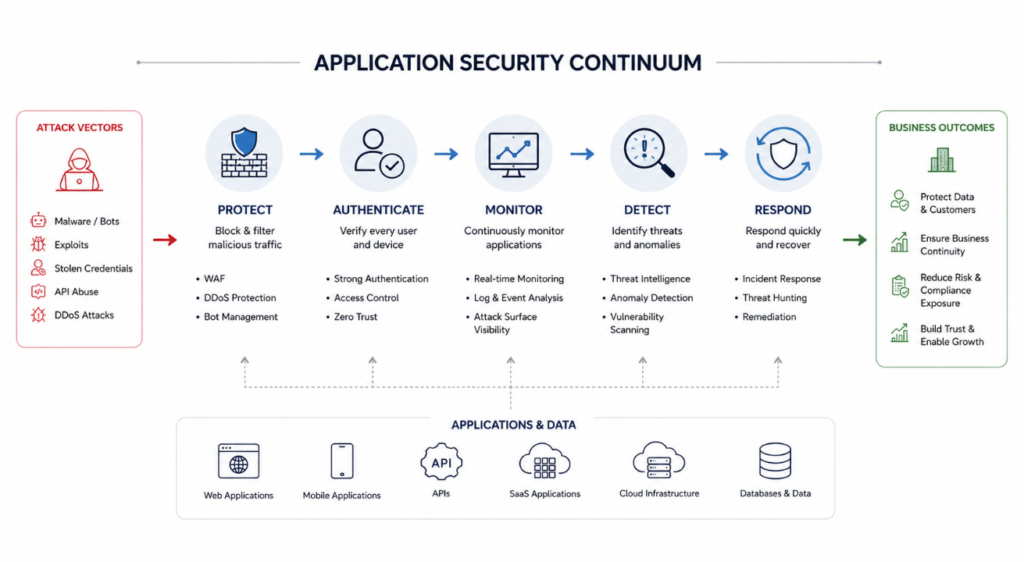
A mature application security strategy should combine multiple defensive layers.
A typical architecture may include:
Secure Development → Vulnerability Management → WAF → API Security → Zero Trust → EDR/XDR → NDR → SOC → Incident Response
Each layer addresses different aspects of the threat landscape.
For example, a WAF may block malicious web traffic, while identity controls help prevent unauthorized access. Endpoint security can detect compromised devices, while NDR can identify suspicious network behavior. SOC analysts can correlate these signals and investigate potential attacks.
Why Business Application Security Matters for GCC Organizations
Organizations across the GCC are rapidly digitizing critical services.
Government portals, banking applications, healthcare systems, telecommunications platforms, e-commerce services, energy systems, and enterprise applications increasingly support essential business and public services.
A successful application attack could result in:
- Data exposure
- Financial fraud
- Service disruption
- Customer trust issues
- Regulatory consequences
- Operational downtime
- Reputational damage
For organizations operating critical or highly regulated environments, application security must therefore become part of broader GCC Cybersecurity and enterprise risk management strategies.
Security teams should continuously assess applications rather than treating security as a one-time deployment activity.
How CORVIT MSSP Helps Protect Business Applications
As a Managed Security Service Provider (MSSP), CORVIT MSSP helps organizations build layered security strategies designed to protect applications, users, infrastructure, and data.
CORVIT MSSP’s cybersecurity portfolio includes capabilities such as:
- Managed WAF
- Managed Firewall/IPS
- Cloud Security
- Zero Trust Security
- EDR/XDR
- AI-Driven NDR
- Identity Threat Detection & Response
- Threat Intelligence
- Vulnerability Management
- 24/7 Security Operations Center
- Digital Forensics & Incident Response
These capabilities can work together to provide visibility across the application environment while helping security teams detect, investigate, and respond to threats.
The objective is not simply to protect an application at the network edge.
It is to create an integrated security architecture that protects the application, its users, APIs, identities, infrastructure, and data throughout the attack lifecycle.
Conclusion
Business applications have become one of the most important battlegrounds in modern cybersecurity because they connect organizations directly to customers, employees, data, cloud services, and critical business processes. As attackers increasingly exploit application vulnerabilities, APIs, credentials, and legitimate business functionality, organizations need to move beyond perimeter-focused security toward layered protection that combines WAF, API Security, Zero Trust, Cloud Security, EDR/XDR, NDR, SOC monitoring, Threat Intelligence, and Incident Response. For GCC organizations, securing business applications is no longer simply an IT responsibility; it is a business resilience priority.
Protect Your Business Applications with CORVIT MSSP
As the application attack surface continues to expand, organizations need continuous visibility, layered protection, and expert security operations. CORVIT MSSP helps organizations strengthen application and enterprise security through managed WAF, Firewall/IPS, Zero Trust, Cloud Security, EDR/XDR, AI-Driven NDR, Threat Intelligence, and 24/7 Cyber Defense Center capabilities.
Explore CORVIT MSSP Services: https://corvit.com/networks/mssp/
FAQs
- Why are attackers targeting business applications?
Business applications provide access to valuable data, identities, transactions, and critical business processes. Attackers can exploit application vulnerabilities, APIs, stolen credentials, and business logic weaknesses to gain unauthorized access or disrupt operations.
- Is a WAF enough to protect a business application?
No. A WAF is an important defensive layer, but it should be combined with secure development, API Security, identity protection, vulnerability management, Cloud Security, monitoring, and Incident Response.
- Why is API Security important for modern organizations?
APIs connect applications, users, cloud services, databases, and third-party platforms. Weak authentication, authorization problems, excessive data exposure, and insecure API configurations can create significant security risks.
- How does Zero Trust help protect business applications?
Zero Trust reduces implicit trust by continuously evaluating access based on identity, device, application, context, and risk. This can help limit unauthorized access and reduce the potential impact of compromised accounts.
- How can CORVIT MSSP help organizations secure business applications?
CORVIT MSSP provides layered managed security capabilities including Managed WAF, Firewall/IPS, Zero Trust, Cloud Security, EDR/XDR, AI-Driven NDR, Threat Intelligence, SOC monitoring, and Digital Forensics & Incident Response.