From Vulnerability to Exploitation: How Attackers Turn Security Gaps Into Breaches
October 6, 2026Explore Cyber First Qatar 2026 priorities, including AI-driven defence, 24/7 threat monitoring, critical infrastructure protection and cyber resilience with CORVIT MSSP.
Introduction
As Qatar continues to expand its digital economy, cybersecurity is becoming increasingly important to business continuity, public trust, and national resilience. Cloud adoption, connected infrastructure, digital services, and artificial intelligence are creating new opportunities for organizations. At the same time, these developments are expanding the environments that security teams must protect.
The challenge is no longer simply to deploy security tools or meet a defined set of compliance requirements. Organizations must understand their exposure, identify suspicious activity, respond effectively to incidents, and recover without unnecessary disruption.
These priorities will feature prominently at Cyber First Qatar 2026, scheduled for 10 November 2026 at Grand Hyatt Doha Hotel & Villas. The summit brings together cybersecurity and technology leaders to discuss Qatar’s digital future, AI and cyber defense, critical infrastructure, and the relationship between compliance and cyber resilience. Learn more about Cyber First Qatar 2026.
For organizations preparing for this evolving security landscape, the event provides a timely opportunity to consider a practical question: How can cybersecurity move from a collection of individual controls to a continuous, coordinated defense capability?
For CORVIT MSSP, this question aligns directly with the role of managed cybersecurity services: helping organizations improve visibility, strengthen protection, monitor threats, coordinate incident response, and build more resilient operations.
Why Cyber Resilience Matters for Qatar’s Digital Future
Cyber resilience is the ability to anticipate, withstand, respond to, and recover from cyber incidents while maintaining essential business operations. It recognizes an important reality: preventive security controls are necessary, but no organization can assume that every attack will be stopped.
A business may have firewalls, endpoint protection, access controls, and security policies in place. However, those controls must remain effective as infrastructure changes, new applications are introduced, employees adopt new working practices, and attackers develop different techniques.
A compromised account, an exposed cloud service, an unpatched vulnerability, or suspicious activity inside a network can create risks that are difficult to identify through isolated security products alone.
Resilience therefore requires a broader approach. Organizations need to understand where they are exposed, establish appropriate safeguards, detect unusual behavior, investigate incidents, and maintain reliable recovery procedures.
For Qatar’s interconnected sectors, including government, banking, telecommunications, energy, healthcare, and critical infrastructure, these capabilities are particularly important because a security incident can affect more than a single system. It may disrupt customer services, business operations, sensitive information, or essential processes.
Cyber resilience should consequently be treated as an ongoing business capability rather than a one-time technical project.
From Compliance to Continuous Security
Compliance frameworks provide important direction. They help organizations establish policies, assign responsibilities, assess risks, and demonstrate that appropriate controls exist.
However, passing an assessment does not automatically mean that an organization is protected against every emerging threat.
A control may be documented but incorrectly configured. A user account may retain excessive privileges. A cloud environment may change after its initial security review. An endpoint may begin communicating with a suspicious external system. Each situation can introduce risk even when an organization has previously completed a compliance exercise.
The next step is to connect governance with operational security.
This means reviewing security controls regularly, monitoring important systems, validating configurations, assessing vulnerabilities, and ensuring that detected issues lead to meaningful action. It also means establishing clear ownership: security findings must reach the people who can investigate and remediate them.
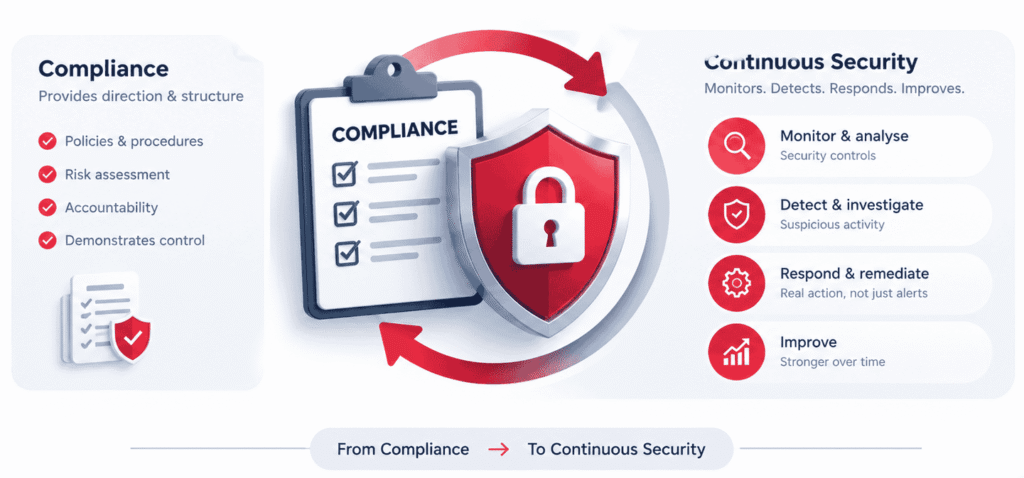
CORVIT MSSP supports this broader approach through a portfolio spanning technical assessments, security governance, preventive controls, continuous monitoring, incident response, and recovery. Its managed security services are structured around the connected stages of Access, Govern, Protect, Detect, Respond, Recover, and Evolve.
The objective is to help organizations connect security planning with day-to-day operations, rather than treating compliance, monitoring, and incident response as unrelated activities.
AI and Automation: Strengthening Cyber Defense Responsibly
Artificial intelligence is changing the way security teams analyze activity, recognize patterns, and investigate potential threats. It can help identify unusual behavior, correlate signals across systems, and prioritize alerts that require closer attention.
Automation can also reduce repetitive operational work. For example, a security workflow may collect information about a suspicious login, retrieve relevant endpoint events, enrich an alert with threat intelligence, and prepare an investigation summary for an analyst.
These capabilities can improve efficiency, particularly in environments generating large volumes of security events.
However, AI is not a replacement for sound security architecture or experienced security professionals. Models can produce inaccurate conclusions, incomplete context can lead to misleading results, and automated actions can cause disruption if they are poorly designed.
Organizations must therefore determine which tasks can safely be automated, which decisions require human approval, and how automated outcomes will be validated.
A practical AI-enabled security strategy should include reliable data sources, clear permissions, documented response procedures, testing, monitoring, and escalation paths for uncertain or high-impact cases.
CORVIT MSSP’s Cyber Defense Center (SOC) and AI-Driven Network Detection and Response (NDR) are relevant to this broader defense model. Continuous monitoring and intelligent network analysis can help security teams identify suspicious activity and investigate potential threats more effectively.
The goal is not to automate every decision. It is to help security teams use their time and available evidence more effectively while maintaining appropriate oversight.
Why 24/7 Security Monitoring Is Essential
Cyber threats do not necessarily follow business hours. Suspicious activity may occur overnight, during weekends, or when internal teams are occupied with other operational responsibilities.
Without appropriate monitoring and escalation procedures, an alert can remain unnoticed or unresolved. Even when an organization has security products installed, it may lack the people, processes, or integration needed to interpret the signals they generate.
A mature monitoring capability connects event collection, detection, investigation, escalation, and response.
Security teams need visibility across relevant parts of the environment, including endpoints, networks, cloud resources, identities, and other critical assets. They also need context to distinguish routine activity from behavior that warrants investigation.
A centralized Security Operations Center (SOC) can support this process by correlating security events, investigating suspicious behavior, and escalating incidents according to defined procedures.
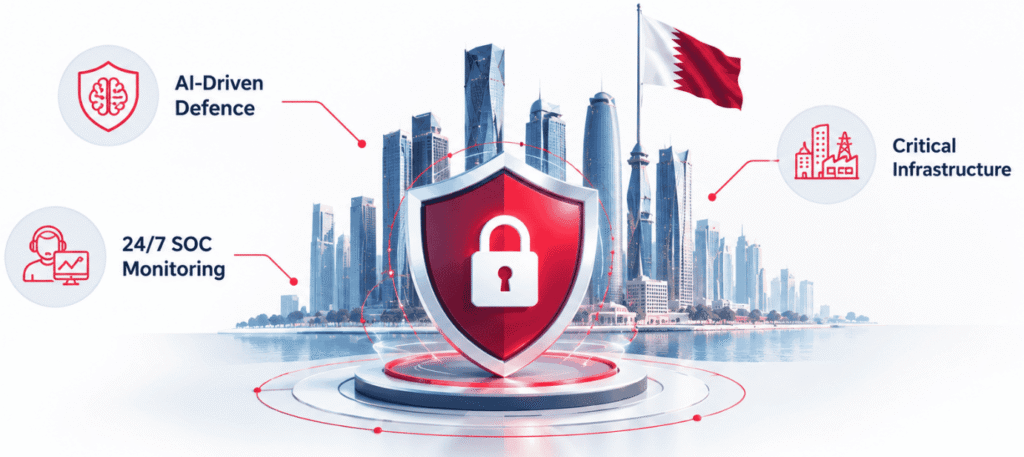
CORVIT MSSP provides a Cyber Defense Center with 24/7 security monitoring and threat analysis. Its EDR/XDR services and AI-driven NDR capabilities can contribute endpoint and network visibility to an integrated security approach.
For organizations, the important consideration is not simply whether monitoring is available. It is whether alerts are reviewed appropriately, critical incidents reach the right responders, and the response process is clear before an incident occurs.
Protecting Critical Infrastructure and Connected Environments
As digital and operational systems become more interconnected, cybersecurity must extend beyond traditional office networks.
Industrial Control Systems (ICS), Supervisory Control and Data Acquisition (SCADA) environments, operational technology (OT), and Internet of Things (IoT) devices support processes across sectors such as energy, utilities, manufacturing, transportation, and smart infrastructure.
These environments present distinct security challenges. Some devices have long operational lifecycles, some cannot be patched easily, and some systems prioritize availability and safety over frequent changes. Traditional IT security approaches may not be suitable for every industrial environment.
Effective protection begins with understanding the environment: identifying connected assets, mapping communications, assessing exposure, and establishing appropriate monitoring and access controls.
Organizations must also consider how IT and OT systems interact. A compromise in a connected enterprise environment may create risks for industrial systems when network segmentation, identity controls, or monitoring are insufficient.
CORVIT MSSP’s ICS/SCADA/IoT Security Monitoring service is relevant to organizations seeking greater visibility into connected operational environments.
A sound strategy should be designed around the operational requirements of each environment, with security changes carefully evaluated to avoid unnecessary disruption. Protecting critical systems requires coordination between cybersecurity teams, IT operations, OT engineers, and business owners.
Threat Intelligence and Proactive Threat Hunting
Reactive security focuses on investigating alerts after a detection system identifies suspicious activity. Proactive security adds another layer: looking for potential threats that may not have generated a clear alert.
Threat intelligence helps organizations understand attacker behavior, emerging techniques, and indicators associated with malicious activity. When relevant to an organization’s technology and risk profile, this information can guide monitoring priorities and help teams investigate suspicious events.
Threat hunting takes a more investigative approach. Analysts develop hypotheses about possible attacker activity and examine available telemetry to identify evidence that automated detections may have missed.
For example, an investigation may examine unusual authentication patterns, unexpected administrative activity, suspicious network connections, or signs of movement between systems. Findings can then inform detection rules, incident response procedures, and security improvements.
Neither threat intelligence nor threat hunting guarantees that every threat will be discovered. Their value depends on the quality of available data, the relevance of the intelligence, and the ability to turn findings into practical action.
CORVIT MSSP offers Threat Intelligence and Threat Hunting capabilities that fit into a proactive security strategy. These activities can complement continuous monitoring by helping organizations investigate risks, refine detection priorities, and improve their understanding of potential threats.
Incident Response and Recovery: Preparing for What Prevention Misses
Even a well-designed security program needs a plan for incidents that succeed in bypassing preventive controls.
During a cyber incident, uncertainty can slow decisions. Teams may need to determine which systems are affected, whether an attacker still has access, what information may have been exposed, and which services can safely remain operational.
A defined incident response process helps establish responsibilities, escalation routes, evidence-handling procedures, containment options, and communication requirements before a crisis occurs.
Digital forensics can help reconstruct events and identify the likely scope and cause of an incident. Containment can limit further activity, while remediation addresses the underlying weaknesses that enabled the incident.
Recovery must also be planned. Backups, restoration procedures, business continuity arrangements, and recovery testing help organizations understand whether critical services can be restored within acceptable timeframes.
CORVIT MSSP’s Digital Forensics and Incident Response (DFIR) and Backup and Recovery services align with these requirements.
Organizations should regularly test their incident response and recovery plans, verify that backups can be restored, and ensure that relevant teams understand their responsibilities. A plan that exists only in documentation may not be sufficient when decisions must be made under pressure.
Building a Practical Cyber Resilience Roadmap
Organizations do not need to transform every part of their security program at once. A structured roadmap can help prioritize improvements according to risk, operational requirements, and available resources.
A practical starting point includes the following steps:
- Understand the exposure. Identify important assets, internet-facing systems, sensitive data, privileged accounts, cloud resources, and connections between IT and operational environments. Use assessments and penetration testing where appropriate to validate weaknesses.
- Strengthen governance and controls. Assign responsibility for security risks, review access privileges, establish configuration standards, and ensure that security policies translate into operational practices.
- Improve detection and visibility. Identify gaps in logging and monitoring. Determine which systems need continuous oversight and how alerts will be investigated and escalated.
- Define response procedures. Establish incident severity levels, decision-making authority, containment procedures, communication plans, and evidence-preservation requirements.
- Validate recovery readiness. Test backups, restoration procedures, and business continuity arrangements. Confirm that recovery plans address the systems and processes most important to the organization.
- Measure and improve. Review incident trends, recurring vulnerabilities, detection gaps, response times, and lessons learned. Use these findings to update controls and operational procedures.

CORVIT MSSP’s integrated service portfolio can help organizations address different parts of this lifecycle. The appropriate combination depends on each organization’s existing capabilities, risk exposure, regulatory obligations, and operational needs.
What Organizations Should Take Away from Cyber First Qatar 2026
Cyber First Qatar 2026 provides a timely setting for cybersecurity leaders to examine how digital transformation, AI adoption, critical infrastructure protection, and operational resilience intersect. Its published program includes discussions on AI and cyber defense as well as moving from compliance toward cyber resilience. View the event details and agenda.
For organizations, the most useful outcome should be a clearer understanding of what needs to change after the discussions end.
Leaders can use the event as an opportunity to review whether their security strategy reflects their current business environment, whether monitoring and incident response responsibilities are clearly defined, and whether recovery arrangements have been tested.
They can also examine whether their teams have sufficient visibility across cloud, endpoint, network, identity, and industrial environments, and whether security findings lead to measurable improvements.
Above all, cyber resilience requires collaboration. Business leadership, IT operations, security professionals, risk teams, and technology partners must understand their responsibilities and work toward shared priorities.
Technology plays an important role, but effective security also depends on people, processes, governance, and continuous improvement.
How CORVIT MSSP Supports Continuous Cyber Resilience
CORVIT MSSP helps organizations strengthen their security posture through an integrated portfolio of managed cybersecurity services. Its approach connects exposure assessment and governance with preventive security, continuous monitoring, incident response, recovery, and ongoing improvement.
Depending on an organization’s needs, relevant capabilities may include:
- Cyber Defense Center (SOC): 24/7 security monitoring, event analysis, and incident escalation.
- EDR/XDR and AI-Driven NDR: Endpoint and network threat visibility and detection.
- Threat Intelligence and Threat Hunting: Context-driven investigation and proactive identification of potential threats.
- Penetration Testing and Technical Assessments: Identification and validation of security weaknesses.
- ICS/SCADA/IoT Security Monitoring: Visibility into connected industrial and operational environments.
- DFIR and Backup & Recovery: Incident investigation, containment support, and recovery readiness.
These services are intended to support a coordinated security program rather than a collection of disconnected tools. The right service mix should be determined by an organization’s specific requirements and risk profile.
To learn more, visit the CORVIT MSSP website or contact the CORVIT team to discuss your cybersecurity priorities.
Conclusion
Cyber First Qatar 2026 highlights an important conversation for organizations navigating Qatar’s digital future: cybersecurity must support innovation while protecting the systems, information, and services that businesses and communities depend on.
Achieving this requires more than preventive controls or periodic compliance reviews. Organizations need continuous visibility, responsible use of AI and automation, effective threat detection, coordinated incident response, and tested recovery capabilities.
Cyber resilience develops over time. It improves when organizations understand their exposure, act on security findings, learn from incidents, and regularly validate their readiness.
For businesses in Qatar, the path forward is to translate cybersecurity priorities into practical, measurable improvements. With the right combination of governance, technology, expertise, and managed security capabilities, organizations can work toward stronger protection and more resilient operations.
Explore CORVIT MSSP: https://corvit.com/networks/mssp/
FAQs
1- What is Cyber First Qatar 2026?
Cyber First Qatar 2026 is a cybersecurity summit scheduled for 10 November 2026 at Grand Hyatt Doha Hotel & Villas in Doha. Its published program focuses on cybersecurity leadership, AI and cyber defense, digital trust, and cyber resilience. Visit the official event page for details.
2- Why is cyber resilience important for organizations in Qatar?
Cyber resilience helps organizations prepare for, withstand, respond to, and recover from cyber incidents. It supports business continuity, protection of sensitive information, and the reliability of digital and operational services.
3- How can AI improve cybersecurity operations?
AI can help analyze security data, identify unusual patterns, prioritize alerts, and support investigations. Its effectiveness depends on data quality, appropriate validation, clear operating boundaries, and human oversight for important decisions.
4- How can CORVIT MSSP help organizations strengthen cybersecurity?
CORVIT MSSP provides an integrated portfolio that includes a Cyber Defense Center, EDR/XDR, AI-driven NDR, threat intelligence, threat hunting, technical assessments, ICS/SCADA/IoT monitoring, incident response, and recovery services. Organizations can explore the CORVIT MSSP portfolio to identify services relevant to their requirements.