
How Digital Forensics & Incident Response (DFIR) Helps Organizations Recover Faster from Cyberattacks
August 11, 2026
How AI Is Changing Both Cyberattacks and Cyber Defense
August 25, 2026Discover why traditional firewalls fall short and how CORVIT MSSP’s layered security strengthens modern enterprise cyber defense.
Introduction
For decades, the firewall has been one of the most important components of enterprise cybersecurity. Organizations deployed firewalls at the network perimeter to control traffic, block unauthorized connections, and protect internal systems from external threats.
However, the modern enterprise no longer has a simple network perimeter.
Employees work remotely. Applications run in the cloud. Business data moves across SaaS platforms. Customers access web applications from anywhere. Branch offices connect directly to cloud environments, while IoT and Operational Technology (OT) systems increasingly interact with corporate networks.
At the same time, cyberattack techniques have become significantly more sophisticated.
Attackers are no longer relying exclusively on obvious malicious network traffic. They can compromise legitimate credentials, exploit vulnerable applications, abuse cloud identities, move laterally through trusted connections, deploy ransomware, and use encrypted communications to conceal malicious activity.
As a result, simply deploying a traditional firewall is no longer sufficient to protect the entire enterprise attack surface.
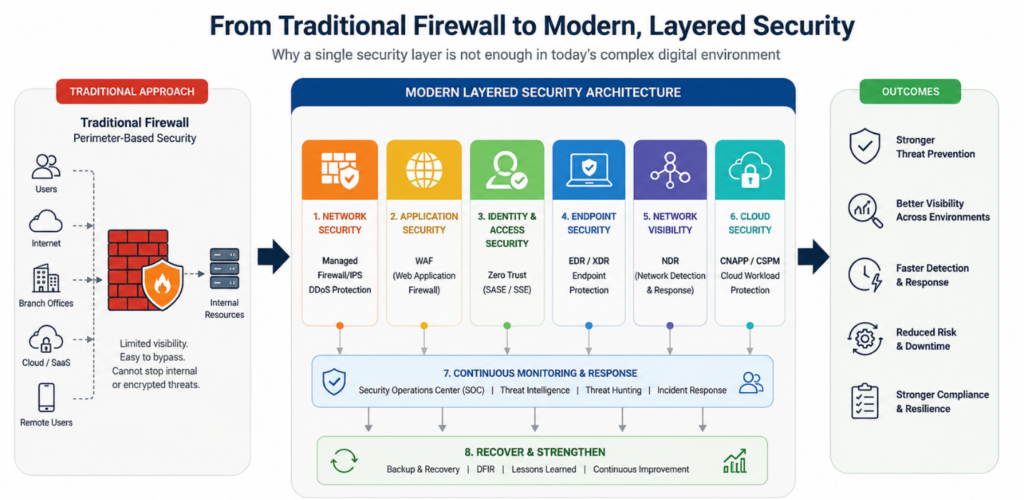
Modern organizations require a layered cybersecurity architecture that combines network security with identity protection, endpoint security, application security, cloud security, threat detection, and continuous monitoring.
This is where modern Managed Firewall/IPS, Web Application Firewall (WAF), Zero Trust, EDR/XDR, NDR, and a 24/7 Security Operations Center (SOC) become essential components of an enterprise defense strategy.
Understanding the Traditional Firewall
A traditional firewall is primarily designed to control network traffic according to predefined security policies.
It typically evaluates characteristics such as:
- Source IP address
- Destination IP address
- Port numbers
- Network protocols
- Connection states
- Predefined rules
The basic principle is straightforward:
Allow legitimate traffic. Block unauthorized traffic.
This model was highly effective when organizations operated primarily from centralized corporate networks where applications, users, and data were located behind a defined network perimeter.
However, modern organizations have fundamentally changed that model.
Employees may access corporate applications from homes, airports, branch offices, mobile devices, and other locations.
Applications may be hosted across:
- Public cloud platforms
- Private clouds
- SaaS environments
- Data centers
- Hybrid infrastructures
This means the traditional concept of a single, clearly defined security perimeter is becoming increasingly difficult to maintain.
Why the Traditional Network Perimeter Is Disappearing
The modern enterprise is distributed.
Users, applications, devices, and data may exist in completely different locations while still communicating with one another.
Consider a typical modern organization:
Employee → Internet → SaaS Application → Cloud Workload → Corporate Data
The user may never connect directly to the organization’s traditional network perimeter.
Similarly, a branch office may connect directly to cloud applications rather than routing all traffic through a central data center.
This creates new security challenges.
Traditional perimeter-based security can struggle to provide sufficient visibility into:
- User identities
- Application behavior
- Cloud workloads
- Endpoint activity
- SaaS applications
- East-west network traffic
- Encrypted communications
- Remote access
- Privileged activity
The result is a growing gap between where security controls are deployed and where modern business activity actually occurs.
The Growing Limitations of Traditional Firewalls
Traditional firewalls remain valuable security controls, but relying on them as the primary defense mechanism creates several challenges.
1. Attackers Can Bypass the Perimeter
Modern attackers often use legitimate credentials rather than attempting to force their way through a firewall.
For example:
Phishing → Credential Theft → Account Compromise → Legitimate Login → Internal Access
From the firewall’s perspective, the connection may appear legitimate.
The security problem is therefore no longer simply:
“Is this connection allowed?”
It becomes:
“Is this user, device, application, and activity trustworthy?”
2. Encrypted Traffic Creates Visibility Challenges
A growing percentage of enterprise traffic is encrypted.
While encryption protects legitimate communications, attackers can also use encrypted channels to conceal malicious activity.
Security teams therefore need security technologies capable of analyzing traffic, endpoints, behavior, and context rather than relying exclusively on traditional network rules.
3. Cloud Applications Are Outside the Traditional Perimeter
Cloud adoption has changed where applications and data reside.
Organizations may use multiple cloud platforms and hundreds of SaaS applications.
A traditional firewall located at a corporate data center cannot provide complete visibility into every cloud workload, user interaction, identity event, and application transaction.
This is why Cloud Security (CNAPP/CSPM) has become an increasingly important component of modern enterprise security.
4. Remote Users Do Not Always Operate Behind Corporate Firewalls
Hybrid and remote workforces have fundamentally changed network architecture.
Employees may access business applications from unmanaged or partially managed networks.
Traditional perimeter controls cannot provide sufficient protection when users and devices operate outside the corporate network.
This is one reason organizations are increasingly adopting identity-centric approaches such as Zero Trust.
5. Firewalls Cannot Stop Every Endpoint Threat
Suppose an employee downloads malware through a legitimate web connection.
The firewall may allow the connection because the traffic itself is permitted.
The threat may then execute directly on the endpoint.
This is where Endpoint Detection & Response (EDR/XDR) becomes important.
EDR/XDR can monitor endpoint behavior, identify suspicious activity, investigate potential compromise, and support automated containment.
Why Firewalls Need to Become Part of a Layered Security Strategy
The answer is not to eliminate firewalls.
Instead, organizations should stop treating the firewall as the single security barrier.
A modern enterprise security architecture should combine multiple defensive layers.
A simplified approach is:
Network → Application → Endpoint → Identity → Cloud → Data → Detection → Response
Each layer addresses different attack vectors.
For example:
- Managed Firewall/IPS protects network boundaries.
- WAF protects web applications.
- EDR/XDR protects endpoints.
- Zero Trust protects user and application access.
- Cloud Security protects cloud workloads and configurations.
- NDR monitors network behavior.
- SOC provides continuous monitoring and response.
- Threat Intelligence provides context about emerging threats.
- DFIR supports investigation and recovery.
Together, these controls create a more resilient defense architecture.
The Role of Managed Firewall/IPS in Modern Enterprise Security
A modern Managed Firewall/IPS remains an essential component of enterprise cybersecurity.
However, today’s firewall must be continuously managed, monitored, updated, and integrated with other security technologies.
Modern managed firewall capabilities can include:
- Next-generation firewall protection
- Intrusion Prevention
- Malicious traffic blocking
- Policy optimization
- Continuous monitoring
- Threat prevention
- Security configuration management
- Expert incident response
CORVIT’s Managed Firewall/IPS service uses Fortinet-powered technologies with continuous monitoring, policy optimization, intrusion prevention, and expert management to strengthen enterprise network protection.
This transforms the firewall from a static network appliance into a continuously managed security capability.
Why WAF Is Essential for Modern Web Applications
Firewalls primarily protect network traffic.
But modern businesses increasingly depend on web applications and APIs that require specialized application-layer protection.
A Managed Web Application Firewall (WAF) is designed specifically to protect web applications against threats such as:
- SQL injection
- Cross-site scripting
- Malicious bots
- Application exploitation
- Automated attacks
- Suspicious web requests
CORVIT’s Managed WAF combines FortiWAF technology with continuous monitoring, policy optimization, and expert management to protect applications from evolving application-layer threats.
This demonstrates an important security principle:
Protecting the network is not the same as protecting the applications running on that network.
DDoS Protection Requires More Than a Firewall
Distributed Denial-of-Service (DDoS) attacks can overwhelm internet-facing services with enormous volumes of traffic.
A firewall may provide some filtering capabilities, but dedicated DDoS Protection is often required for organizations that depend heavily on the availability of online services.
DDoS protection can help organizations maintain:
- Website availability
- Application availability
- Customer access
- Digital services
- Business continuity
CORVIT’s DDoS Shield provides continuous traffic monitoring, attack detection, mitigation, and high-availability protection for critical digital services.
Why the SOC Is the Missing Layer
Even the strongest security technologies cannot deliver maximum value if nobody is continuously monitoring and investigating the signals they generate.
This is why the Security Operations Center (SOC) has become a central component of modern enterprise defense.
A SOC can bring together intelligence from:
- Firewalls
- EDR/XDR
- NDR
- Cloud platforms
- Identity systems
- Email security
- Applications
- Threat intelligence
Security analysts can then correlate these signals to determine whether an organization is experiencing a genuine cyberattack.
CORVIT’s Cyber Defense Center provides continuous monitoring, integrated threat intelligence, AI-assisted threat analysis, and expert incident response.
This provides something a standalone firewall cannot:
Continuous security visibility across the broader environment.
Why This Matters for GCC Organizations
Organizations across Qatar, Saudi Arabia, the UAE, Bahrain, Kuwait, and Oman are rapidly adopting cloud services, digital platforms, remote work, smart infrastructure, and connected technologies.
Industries such as:
- Government
- Financial services
- Oil and gas
- Healthcare
- Telecommunications
- Manufacturing
- Transportation
- Retail
- Critical infrastructure
increasingly depend on interconnected digital environments.
This creates an attack surface that extends well beyond the traditional corporate network.
For GCC organizations, modern enterprise cybersecurity therefore requires protection across:
Users + Identity + Endpoints + Networks + Applications + Cloud + Data + OT
A firewall remains important—but it must operate as part of this broader security ecosystem.
How CORVIT MSSP Helps Build Layered Enterprise Security
CORVIT MSSP takes an integrated approach to enterprise cybersecurity rather than treating individual security products as isolated solutions.
The CORVIT MSSP portfolio combines capabilities across protection, detection, response, recovery, and continuous improvement, including Managed Firewall/IPS, Managed WAF, DDoS Shield, Zero Trust, Secure Web Gateway, EDR/XDR, AI-Driven NDR, Cloud Security, Threat Intelligence, SOC, and Digital Forensics & Incident Response.
This integrated approach enables organizations to build security around their actual business environment rather than around a single network perimeter.
CORVIT helps organizations:
- Strengthen network protection
- Secure applications
- Protect endpoints
- Secure remote users
- Monitor network behavior
- Protect cloud environments
- Detect threats continuously
- Respond to incidents
- Improve cyber resilience
The objective is simple:
Don’t rely on one security layer when modern attackers can exploit many.
Conclusion
Traditional firewalls are not obsolete—they remain a critical part of enterprise cybersecurity. However, today’s distributed environment means they can no longer provide complete protection alone.
With remote users, cloud applications, multiple platforms, and identity-based threats, organizations need a layered security architecture that combines network, application, endpoint, identity, cloud, and continuous monitoring.
The key question is no longer “Do we have a firewall?” but “Can we detect and respond when an attacker gets past it?”
That’s why modern security combines Managed Firewall/IPS, WAF, Zero Trust, EDR/XDR, NDR, Cloud Security, and a 24/7 SOC.
Move Beyond the Firewall with CORVIT MSSP
Your firewall is an important security layer—but it should not be your only layer of defense.
CORVIT MSSP helps organizations across Qatar and the GCC build integrated cybersecurity architectures that combine prevention, detection, response, and resilience across networks, endpoints, applications, identities, cloud environments, and critical infrastructure.
Explore Managed Firewall/IPS: CORVIT Managed Firewall/IPS
FAQs
- Are traditional firewalls still important for enterprise cybersecurity?
Yes. Traditional and next-generation firewalls remain important for controlling network traffic, preventing unauthorized access, and blocking malicious connections. However, they should be part of a layered cybersecurity architecture rather than the organization’s only security control.
- Why are firewalls no longer enough for modern enterprises?
Modern attacks can exploit compromised credentials, endpoints, cloud configurations, applications, and legitimate network connections. A firewall primarily protects network boundaries and therefore cannot provide complete visibility across every part of a modern enterprise environment.
- What should organizations use alongside a firewall?
Organizations should consider complementary technologies such as Managed Firewall/IPS, WAF, EDR/XDR, NDR, Zero Trust, Cloud Security, DDoS Protection, Threat Intelligence, and a 24/7 SOC. The appropriate combination depends on the organization’s architecture, risk profile, regulatory requirements, and business needs.
- What is the difference between a firewall and NDR?
A firewall primarily controls and filters network traffic according to security policies. NDR focuses on analyzing network behavior to identify suspicious patterns, anomalies, lateral movement, and other potential threats. They perform different but complementary security functions.